
Summary: How Predictive Attribution Forecasts B2B Pipeline
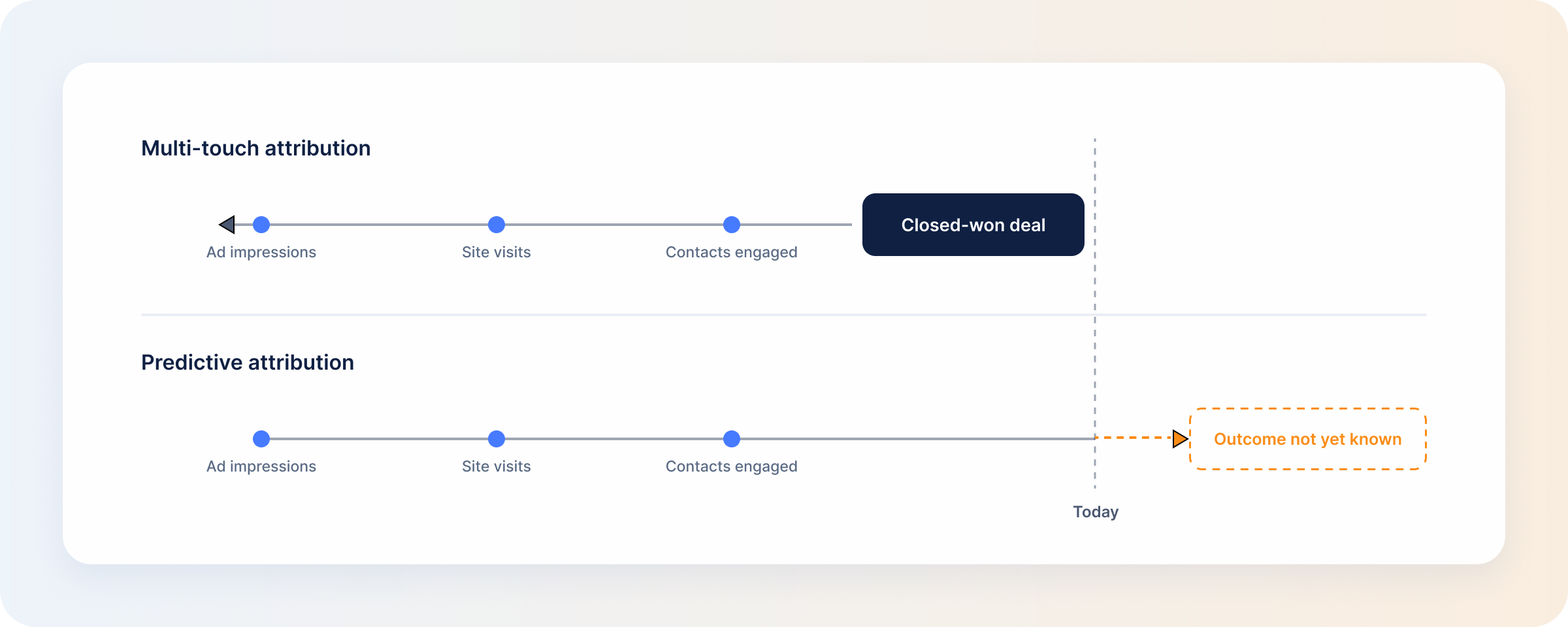
Predictive attribution estimates which accounts and touchpoints are likely to produce future pipeline, using patterns in historical conversion data rather than judgement calls. Traditional attribution looks backward and explains which channels touched a deal that already closed. Predictive attribution looks forward, reading current engagement against the patterns that preceded past wins.
This article covers what predictive attribution means for B2B teams, which account signals actually point to future pipeline, how those signals become a score, and where the whole approach breaks down.
What Is Predictive Attribution?
Predictive attribution is a modelling approach, not a product category any single vendor owns. It uses historical touchpoint and outcome data to estimate the probability that an account will convert, rather than dividing credit for a conversion that has already happened. Where traditional attribution answers “what worked,” predictive attribution answers “what is likely to work next.”
How Does Predictive Attribution Work?
Historical touchpoints and their outcomes, closed-won and closed-lost, become training data. A model learns which sequences and combinations of touchpoints tended to precede closed-won revenue, then scores new accounts against those same patterns to estimate their likelihood of converting. The output is always a probability, never a fact.
Three techniques get lumped together in this conversation, and the differences matter. Statistical models surface correlations between touchpoints and outcomes at the account level, with weightings you set and can inspect. Machine learning classifiers do a similar job at greater scale and work out the weightings themselves, which makes them stronger on volume and harder to explain to a CFO. Media mix modeling is the aggregate cousin, operating on channels and campaigns rather than individual accounts, and it suits budget decisions far better than account prioritisation.
Predictive Attribution vs. Traditional Multi-Touch Attribution
The two answer different questions, need different inputs, and fail in different ways.
| Multi-Touch Attribution | Predictive Attribution | |
|---|---|---|
| What it answers | Which touchpoints get credit for a deal that closed | Which accounts and touchpoints are likely to convert next |
| What it needs | Consistent, complete tracking across channels | Enough historical outcome data to learn from |
| When it’s useful | Reporting, spend audits, closed-won analysis | Forecasting pipeline, ranking accounts before conversion |
| Where it fails | Says nothing about what is coming | Inherits every gap in the history it learned from |
Multi-touch is retrospective and auditable; predictive is forward-looking and probabilistic. Neither makes the other obsolete, and a team without a working multi-touch attribution model has no reliable history to train a predictive one on in the first place.
Benefits of Predictive Attribution for B2B Marketing
- Earlier budget signals in long sales cycles. B2B sales cycles run long enough that waiting on closed-won data to judge a campaign costs an entire quarter of learning. Predictive attribution reads engagement patterns while a campaign is still live, so budget decisions get made on signal that arrives weeks before any close date could.
- Credit for upper-funnel activity that last-click erases. Last-click attribution hands full credit to whatever touchpoint sat closest to a form fill, wiping out the ad impressions and content that built the buyer’s interest. A predictive model weighs those earlier touchpoints against historical conversion patterns instead of discarding them.
- Account prioritisation before an opportunity exists. Most sales and marketing alignment starts only once an account lands in the CRM as a lead. Predictive attribution works earlier, flagging accounts whose engagement resembles past closed-won patterns so reps can prioritise before a deal officially exists.
- A defensible answer when finance asks what the quarter looks like. Forecasting conversations built on rep instinct or flat historical extrapolation rarely survive scrutiny. A predictive model puts account-level engagement patterns behind the number instead, and gives marketing and sales the same data to argue from.
Which B2B Account Signals Predict Future Pipeline?
LinkedIn Ad Engagement Signals
A single click from a single contact tells you almost nothing. What points to pipeline is a cluster of people from one account engaging with several campaigns in a short window, which suggests organisational interest rather than individual curiosity. Capture it by pulling company-level engagement data from Campaign Manager or a connected API and matching it against your target account list, rather than combing through contact-level reports.
Website Intent Signals
Most of your best-fit visitors never fill in a form, and that doesn’t make them worth ignoring. An account returning repeatedly to pricing or product pages carries more intent than one anonymous session ever could. Capture it with company resolution installed through a tag manager, then cross-reference the results against your target account list so the signal isn’t lost in general traffic.
Account-Level and Buying Committee Signals
B2B purchases are made by committees, and that changes what counts as a signal. One person’s engagement is weak in isolation. Several people from the same account engaging independently, across different functions and seniority levels, add up to something much stronger. Capture it by rolling contact-level activity up to the account and tracking how many contacts are engaged and how senior they are, not just raw activity totals.
CRM and Opportunity Signals
Behavioural data means more when it is read against pipeline reality. Rising engagement at an account with no open opportunity is a different situation from the same pattern at an account already deep in an active deal. Capture it by connecting engagement signals to CRM stage and opportunity history, so a signal is interpreted in context rather than floating free of where the account actually stands.
Engagement Recency and Velocity
An account that went quiet two quarters ago is not the same prospect as one that started engaging this week, even when their totals look alike on paper. Direction of travel beats absolute volume: an account going from one touch a month to four in a fortnight is the thing to watch. Capture it by tracking engagement across rolling time windows instead of all-time totals, and build decay into any score so old activity stops carrying full weight.
ICP and Firmographic Fit
Engagement only means something at accounts that could realistically become customers. A wave of activity from companies outside your target industry or size range is just noise. Capture it by scoring every engaged account against your ideal customer profile — industry, headcount, revenue band — before letting behavioural data drive any prioritisation.
How AI Turns B2B Signals Into Pipeline Predictions
Turning those signals into a usable score takes several steps, and each one shapes the quality of what comes out.
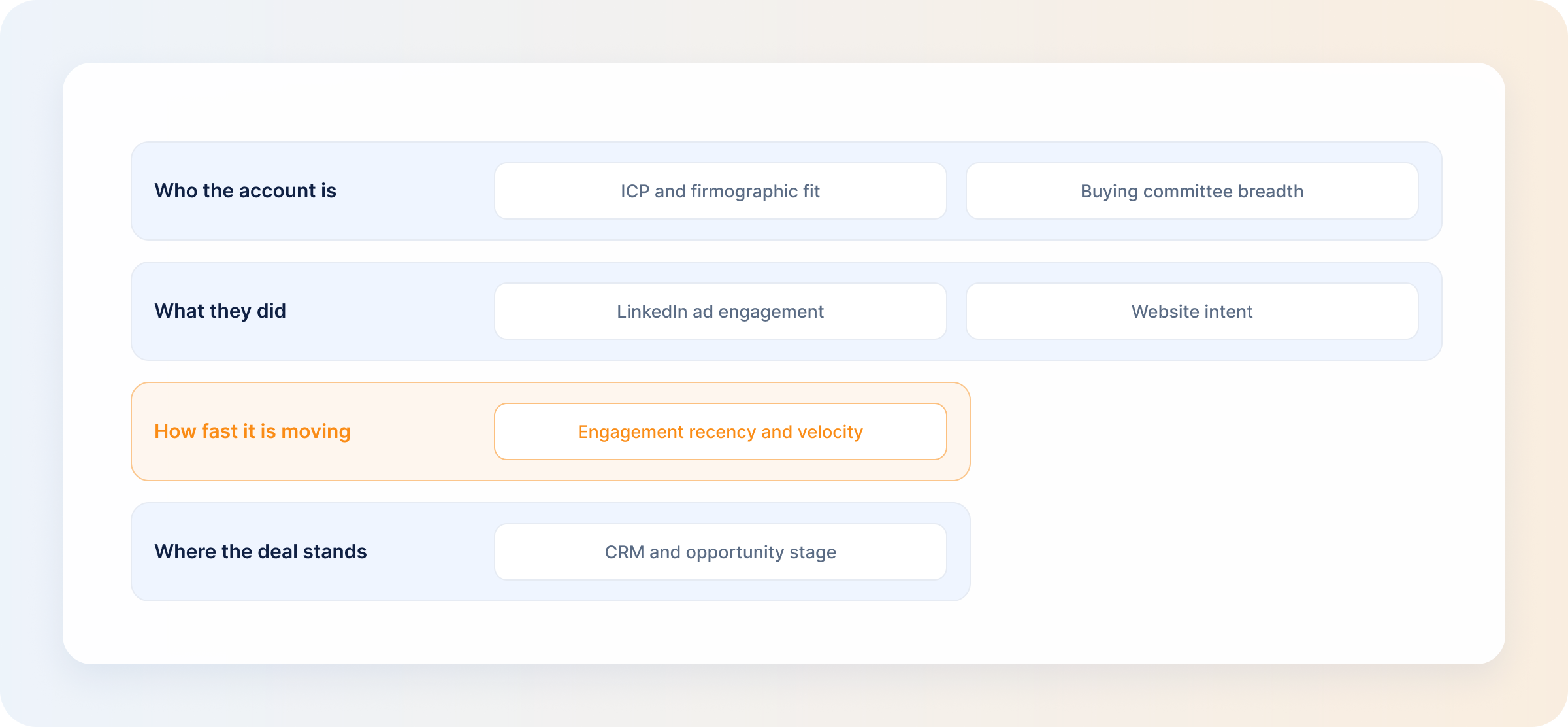
It starts with feature selection: deciding which signals — LinkedIn engagement, website visits, buying committee breadth, recency, ICP fit — get fed into the model and in what form. Not every signal earns a place, and noisy or redundant ones are filtered out before training begins.
The model then trains on historical outcomes, both closed-won and closed-lost. A model trained only on wins has nothing to compare them against and learns nothing about what separates a converting account from one that never does. Losses are half the training data.
From there the model assigns weights, learning which signals matter more based on how consistently they appeared ahead of past outcomes. Those weights are validated against a held-out set of historical data the model never trained on, which checks whether the patterns hold up on unseen accounts instead of merely describing the data the model already saw.
Even a well-validated model drifts as market conditions, buyer behaviour and product-market fit shift. Recalibration — retraining on more recent data at a regular cadence — keeps its patterns current.
Building a Predictive Attribution Workflow for B2B LinkedIn Ads
Before any of the steps below, there is a step zero worth naming honestly: most B2B teams don’t yet have LinkedIn ad data, website activity and CRM records joined at the account level. Getting there, not the modelling, is usually the real project.
- Get clean, joined account-level data. Ad engagement, website visits and CRM records need to sit on the same account rather than in three disconnected systems. Without that join, nothing downstream is trustworthy.
- Define the outcome you’re predicting. “Pipeline” isn’t specific enough. Decide whether the model predicts a new opportunity being created, an opportunity advancing a stage, or a deal closing won — each needs different signals and a different training window.
- Assemble the signals. Pull together LinkedIn engagement, website intent, buying committee breadth, CRM stage history, recency and velocity, and ICP fit for every account in the historical dataset, closed-won and closed-lost alike.
- Choose an approach that matches your data volume. A team with a small set of historical closed deals is better served by simpler statistical models or rules-based scoring than by a classifier that needs far more examples to learn reliably.
- Validate against a period you didn’t train on. Hold out a recent window — a few weeks, or a quarter — that the model never saw, and check whether its scores track outcomes there before trusting them anywhere else.
- Decide what action a score triggers. A score with no attached action is a number on a dashboard. Attach a specific next step to each score range before rolling it out: more ad spend, a sales touch, a change of target account tier.
Using Predictive Pipeline Signals to Optimize LinkedIn Ads
- Shift budget toward segments producing high-scoring accounts. If a particular industry, company size or campaign type consistently produces accounts that score well, that is where the next dollar should go, rather than spread evenly across every segment on the theory that reach is always good.
- Retarget accounts rising in engagement. An account moving from occasional to frequent engagement deserves a dedicated retargeting push while interest is building, rather than the same treatment as a cold account on a prospecting list.
- Suppress accounts that already closed. Spend that keeps reaching accounts that already converted, or that lost and won’t re-engage soon, is spend not reaching accounts still in an active evaluation.
- Brief sales on accounts crossing a threshold. When an account’s engagement pattern crosses a defined threshold, that is the moment for a sales touch, not three weeks later when it surfaces as an inbound lead.
None of this needs a perfect model. It needs a defined action attached to each of those four situations, and someone whose job it is to take it.
Limitations and Accuracy of Predictive Attribution in B2B
- Small data volumes make models noisy. Most B2B companies close a modest number of deals in a given period compared with a consumer business, and a model trained on a thin set of closed-won and closed-lost examples picks up noise alongside signal, mistaking coincidence for pattern.
- Long sales cycles mean slow feedback. A model learns only from outcomes it has observed, and when deals take months to close, it takes months to find out whether a prediction held. That delay slows every round of validation and recalibration.
- Correlation is not causation, and models don’t know the difference. A model will happily learn that accounts visiting the pricing page convert at a higher rate, without knowing whether the visit caused the interest or followed it. Accounts already close to buying visit pricing pages too.
- Models drift. As the market shifts, the ICP evolves and competitors change the landscape, the patterns learned on last year’s data stop describing this year’s buyers. A model that isn’t recalibrated gets quietly less accurate.
- A score is a prior, not evidence. A predictive score tells you what an account resembles, not what caused it to move. Incrementality testing is what settles the question a score can’t: hold a group of similar accounts back from the ads entirely and see whether their outcomes differ. That test is the check on a predictive model rather than a rival to it.
How DemandSense Surfaces the Account Signals B2B Teams Forecast From
Every signal covered so far has to exist and be joined to the account before anyone can forecast from it. That is the layer DemandSense sits in: an account-based intelligence layer rather than a forecasting engine, built to surface the inputs a team — or a model — needs.
The Company Intelligence API shows account-level LinkedIn ad engagement beyond what Campaign Manager’s person-level reporting captures. WebID identifies the companies and people visiting your site who never fill in a form, scores each one against your ideal customer profile, and installs through Google Tag Manager without a developer. Lead scoring runs on those identified visitors, with fit and engagement rules you write yourself and scores that decay, so an account that went quiet doesn’t sit at the top of the list indefinitely.
Journeys lay out each account’s engagement across touchpoints over time. Attribution presets for Awareness, Engagement and Intent apply a 3, 6 or 12-month lookback, so “influenced” means something specific rather than something loose. Opportunity Gap and Rising Accounts are panels you open: engaged accounts missing from the CRM, and accounts heating up this week. They describe what is happening now rather than predicting what comes next. Won ROAS closes the loop by tying revenue on won deals back to spend, and CRM connectors for HubSpot, Salesforce and Attio keep the account record in sync.
Start a 30-day free trial. No card required.
FAQ
How Much Historical Pipeline Data Is Needed for Predictive Attribution?
There is no fixed number. What matters is enough closed-won and closed-lost outcomes across enough full sales cycles for real patterns to stand out from noise. Teams closing a handful of deals a quarter should fix their attribution fundamentals before attempting prediction.
Can LinkedIn Ad Impressions Predict Future Pipeline?
Alone, impressions are a weak signal. In combination they become useful: repeated exposure across several people at one account, followed by site activity from that same account, is the pattern worth watching.
Can Predictive Attribution Work Before an Opportunity Exists?
Yes, and that is the central case for using it in B2B. The gap between a first touchpoint and a first logged opportunity often spans months, and predictive attribution reads engagement patterns across that whole window rather than only after a deal officially opens.
How Does Predictive Attribution Handle Multiple Stakeholders From One Account?
Through account-level aggregation. Individual contact signals roll up to the company, and the composition of the engaged group — how many people, from which functions, at what seniority — becomes a feature in its own right rather than a count of activity.
What Is the Difference Between Predictive Attribution and Intent Scoring?
Intent scoring rates how interested an account looks right now. Predictive attribution estimates the likelihood of a future outcome and can credit specific channels toward it. They overlap heavily in inputs and differ in output. Our guide to buyer intent tracking covers the scoring side in depth.
How Often Should Predictive Attribution Models Be Recalibrated?
Whenever the inputs meaningfully change — a new ICP, new pricing, a new channel mix — and on a regular cadence besides. Relying on a fixed schedule alone risks missing shifts the model should already reflect.