
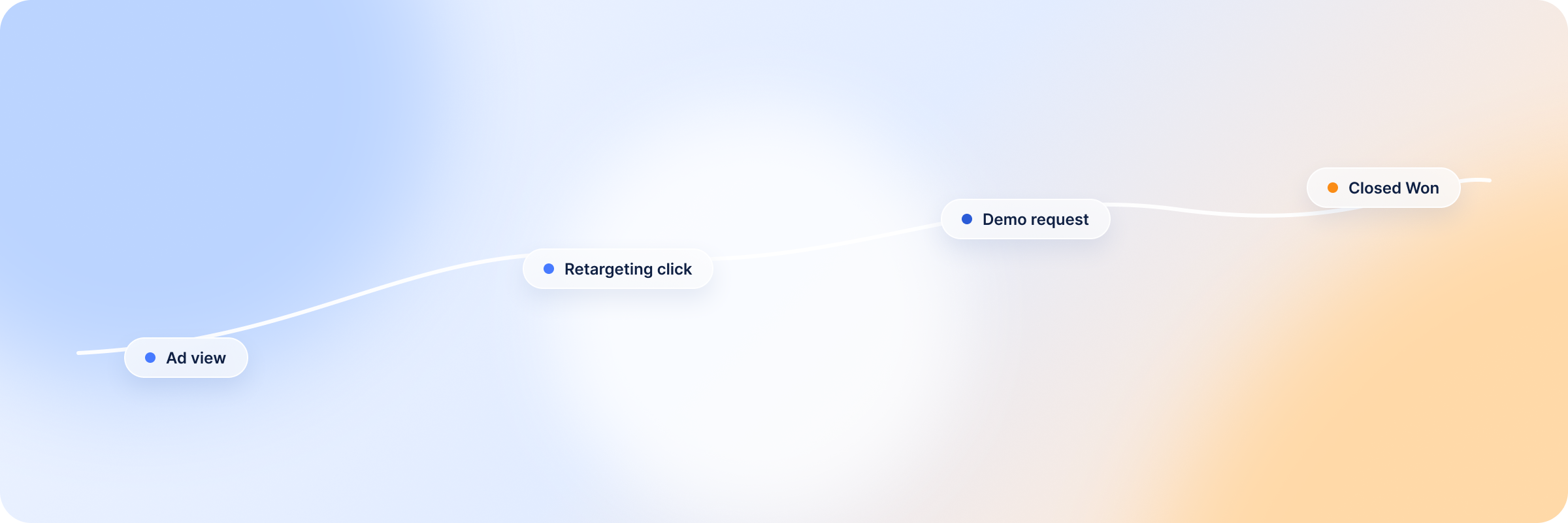
B2B buying cycles run long, involve multiple stakeholders, and rarely end on a single converting click, so any attribution model built for consumer funnels breaks down fast.
The right platform answers two questions:
- Does it connect ad activity to what actually happens in your CRM, not just form fills and website visits?
- Does it track influence at the account level, since B2B deals are won by committees, not individual leads?
DemandSense is built around exactly this account-to-CRM link.
What Is B2B Marketing Attribution?
B2B marketing attribution is the process of connecting marketing touchpoints, such as LinkedIn ads, emails, or website visits, to the revenue outcomes they influence: pipeline created, deals won, and closed revenue in the CRM. Unlike a simple “last click before purchase” model, it has to account for how B2B buying actually happens.
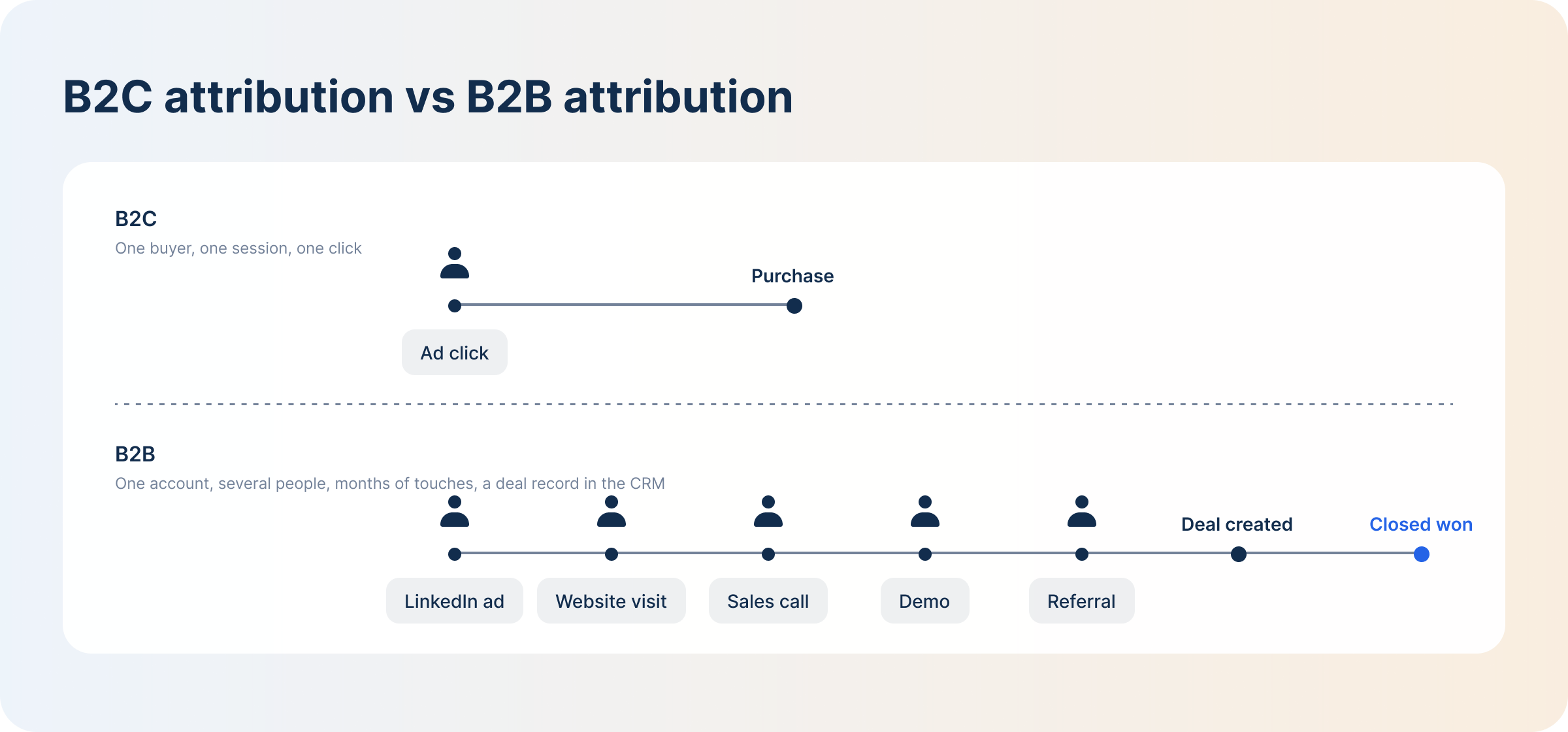
Four things separate B2B attribution from B2C:
- Multiple stakeholders: A single deal can involve five to ten people across departments, each engaging with marketing content at different points, not one buyer making one decision.
- Long sales cycles: B2B deals often take months from first touch to close, so attribution has to look back far enough to capture early-stage influence.
- Offline and human touchpoints: Sales calls, demos, and referrals shape a deal alongside digital ads, and a model that only counts clicks misses most of the picture.
- Deals, not sessions: B2C attribution tracks a session ending in a purchase. B2B attribution tracks a deal record moving through CRM stages over weeks or months, often touched by several people from the same account.
Because of this, B2B attribution models are built around accounts and CRM deal stages, not individual visitor sessions.
Core B2B Marketing Attribution Models for LinkedIn Ads
Most attribution models were built for shorter, single-buyer journeys. Applied to B2B, each one credits touchpoints differently, and each has a scenario where it breaks down.
| Model | What it credits | Where it breaks in B2B |
|---|---|---|
| First touch | 100% to the first interaction | Ignores the sales calls and content that actually closed the deal |
| Last touch | 100% to the final interaction | Ignores everything that built the pipeline months earlier |
| Linear | Equal credit across all touchpoints | Treats a passing ad view the same as a demo request |
| Time decay | More credit to touchpoints closer to close | Undervalues early-stage awareness work in long cycles |
| U-shaped | Heaviest credit to first and lead-conversion touches | Skips the mid-funnel touches a buying committee relies on |
| W-shaped | Credit split across first touch, lead conversion, and opportunity creation | Still misses touches after opportunity creation, common in B2B |
| Full-path | Credit across every stage, including closed-won | Complex to set up and hard to explain to stakeholders |
| Data-driven | Machine-learning weighting based on historical conversion data | Needs a large volume of closed deals most B2B teams don’t have |
How B2B Marketing Attribution Improves LinkedIn Ads ROI
Without account-level attribution, a LinkedIn ads budget gets allocated based on clicks and form fills, signals that say nothing about whether an account ever became a deal. With it, the same budget can be allocated based on which campaigns actually touched accounts that moved through the CRM and closed. That shift changes what “performing” means: a campaign with a low click-through rate but a track record of touching won deals looks different than one with high engagement and no deal history.
Benefits of B2B Marketing Attribution Platforms for Marketing Teams
Account-level attribution changes more than reporting. Here’s what marketing teams get from it:
- Budget allocation based on deal outcomes: Spend can shift toward campaigns proven to touch accounts that close, instead of campaigns that only generate clicks.
- Visibility into the full buying committee: Account-based attribution shows which stakeholders across a deal engaged with marketing, not just the one who filled out a form.
- Earlier detection of high-intent accounts: Accounts showing meaningful ad engagement can be flagged before they ever enter the CRM as a deal.
- Shared reporting between marketing and sales: Both teams can look at the same account-to-deal record instead of reconciling separate lead and pipeline reports.
- Protection against wasted late-stage spend: Ad spend on accounts that are already closed can be identified and redirected.
- A defensible answer to the “what is marketing doing” question: Marketing can point to specific deals in the CRM that its campaigns touched, rather than lead counts alone.
Best B2B Marketing Attribution Platforms for LinkedIn Ads
Here are the best B2B marketing attribution platforms for LinkedIn ads:
| Platform | Best for | Attribution focus | Supported attribution models | Account and revenue data | LinkedIn Ads capabilities | Recommended company size | Main limitation |
|---|---|---|---|---|---|---|---|
| DemandSense | LinkedIn Ads attribution and optimization | Account-level LinkedIn ad influence on CRM revenue | Awareness, Engagement, Intent presets + custom thresholds | Sensor Pixel visitor identification, CRM sync (HubSpot, Salesforce, Attio), per-account journey | Won ROAS, Spend Protection, Conversions API, delivery controls | LinkedIn-first B2B marketing teams | LinkedIn-first: other ad channels are tracked, but the depth is on LinkedIn |
| Dreamdata | Broad B2B revenue attribution | Multi-channel B2B revenue attribution | 3 stage models on free tier; more on Advanced | 2-month history, 5 seats, 1 sync on free tier | LinkedIn tracked as one of several channels | Mid-market to enterprise, multi-channel | No published paid pricing; Advanced is custom |
| HockeyStack | GTM intelligence and multi-touch attribution | Go-to-market and multi-touch attribution | Not clearly specified | GTM and revenue reporting | LinkedIn as one of several tracked channels | Mid-market to enterprise | No published pricing anywhere |
| Fibbler | LinkedIn and Google Ads revenue attribution | Revenue attribution across LinkedIn and Google Ads | Awareness, Engagement, Intent, Custom (12-month lookback) | 12–24 months of history | Native LinkedIn, Google Ads add-on | SMB to mid-market, LinkedIn + Google | Tiers cap at Agency $159/mo; may not suit deeper CRM modeling needs |
| Salesforce Marketing Cloud Intelligence | Salesforce-native attribution | Attribution inside the Salesforce ecosystem | Not clearly specified | Deep Salesforce CRM integration | Ad data ingestion, not LinkedIn-specific | Enterprise, Salesforce-committed | Custom enterprise pricing only |
| 6sense | ABM, intent, and revenue intelligence | Account intent layered with revenue intelligence | Not clearly specified | Intent signals, ABM orchestration | Ad integrations, not LinkedIn-specific | Enterprise ABM programs | No published pricing |
| HubSpot Marketing Hub | Teams already using HubSpot | Attribution reporting inside the HubSpot suite | Not clearly specified | Native, since it’s the CRM | Ad integrations, not LinkedIn-specific | Teams standardized on HubSpot | Attribution reporting gated to higher tiers |
| Adobe Analytics / Marketo Measure | Enterprise attribution and custom analytics | Custom analytics in Salesforce + Marketo stacks | Not clearly specified | Enterprise-grade, highly configurable | Ad data ingestion, not LinkedIn-specific | Large enterprise, Marketo/Salesforce-native | Custom pricing only; heavy implementation lift |
| CaliberMind | Data-driven RevOps teams | RevOps-oriented CRM/warehouse attribution | Not clearly specified | CRM and data warehouse modeling | Ad integrations, not LinkedIn-specific | RevOps-mature mid-market to enterprise | No published pricing; needs data warehouse maturity |
Here’s how each one fits:
- DemandSense is best for teams whose ad spend is concentrated on LinkedIn and who want that spend tied directly to CRM deals. Good fit if LinkedIn is your primary paid channel. Limitation: it is LinkedIn-first. Google Ads, Facebook Ads and StackAdapt connect and their engagement is tracked, but the depth is on LinkedIn.
- Dreamdata is best for broad B2B revenue attribution across many channels. Good fit if you need one model spanning LinkedIn, email, and other paid channels together. Limitation: no published paid pricing, so budgeting means a sales call.
- HockeyStack is best for GTM intelligence and multi-touch attribution. Strong if you want a full go-to-market data layer, not just ad attribution. Limitation: pricing is entirely custom, with no published starting point.
- Fibbler is best for LinkedIn and Google Ads revenue attribution together. Good fit if you split spend between those two platforms. Limitation: published tiers cap out lower than what deeper CRM data modeling needs.
- Salesforce Marketing Cloud Intelligence is best for Salesforce-native attribution. Strong if you already run your revenue stack entirely in Salesforce. Limitation: it’s not a fit outside that ecosystem, and pricing is enterprise-only.
- 6sense is best for ABM, intent, and revenue intelligence combined. Good fit if you need account intent data alongside attribution. Limitation: it’s a broader ABM platform, not a lean attribution-only tool.
- HubSpot Marketing Hub is best for teams already running HubSpot as their CRM. Strong if you don’t want another platform to manage. Limitation: attribution reporting sits behind the higher-priced tiers.
- Adobe Analytics / Marketo Measure is best for enterprise attribution with custom analytics needs. Strong if you’re already Marketo and Salesforce native. Limitation: pricing is custom-only, with a heavy implementation lift.
- CaliberMind is best for data-driven RevOps teams. Good fit if your team already works out of a data warehouse. Limitation: no published pricing, and it needs data maturity to pay off.
Practical DemandSense Use Cases for B2B Attribution
Here are four practical use cases for B2B attribution:
Connect LinkedIn Ads to Pipeline and Revenue
A LinkedIn ad account can report thousands of clicks and dozens of form fills without ever showing whether any of that turned into revenue, because native reporting has no line of sight into the CRM. DemandSense connects LinkedIn ad exposure directly to CRM deal stages, so pipeline and closed revenue can be traced back to the campaigns that actually influenced them. It’s the base layer for account-level attribution, letting marketing see through to revenue rather than stopping at engagement metrics.
Measure Buying Committee Engagement at the Account Level
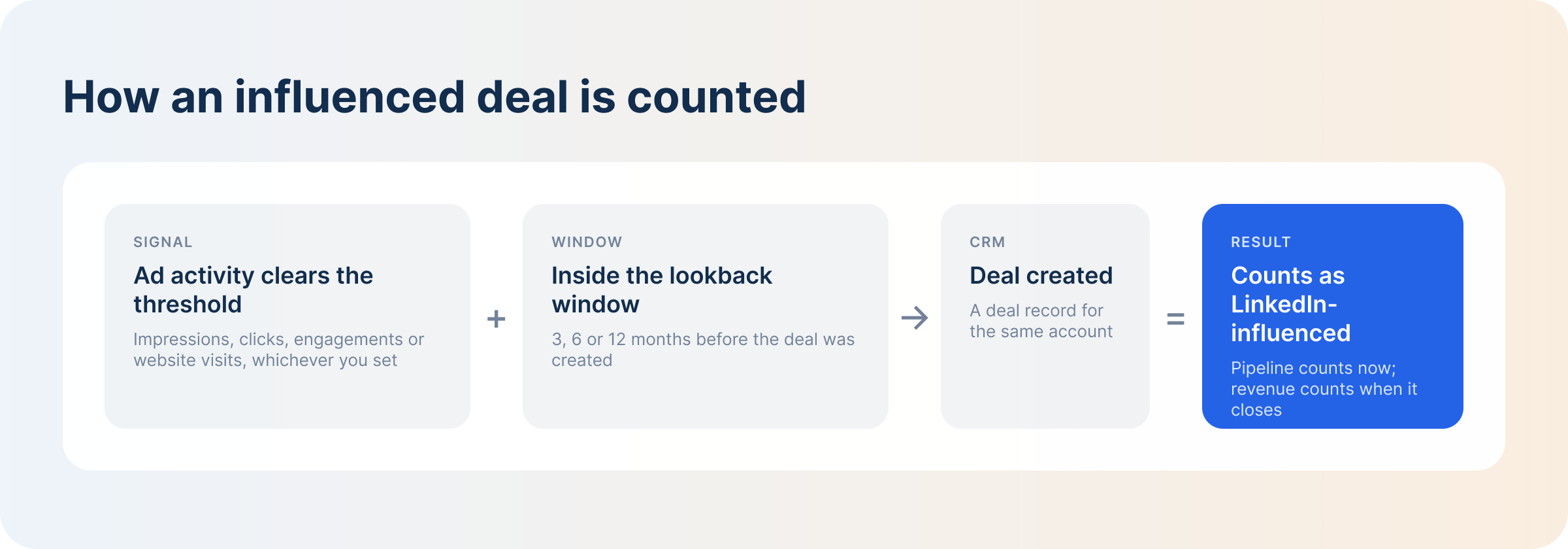
A single stakeholder filling out a form tells you almost nothing about how engaged the account behind them actually is. DemandSense measures influence at the account level, choosing from impressions, clicks, engagements, or website visits, and applying a lookback window of 3, 6, or 12 months before a deal is created. That gives a fuller picture of how a buying committee, not just one contact, interacted with LinkedIn ads before a deal existed.
Identify Which Campaigns Influence Opportunities
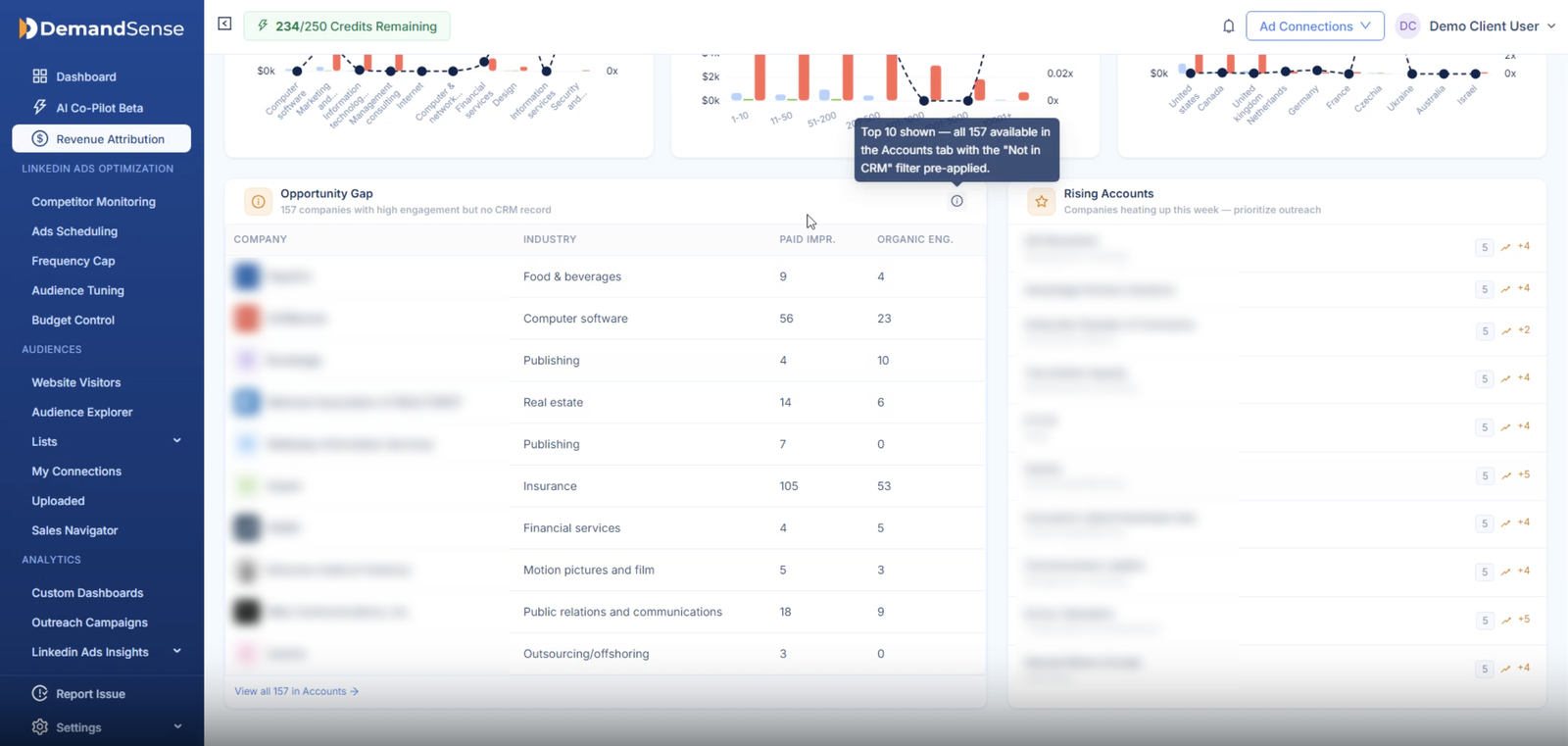
Some accounts engage heavily with LinkedIn ads for weeks before a deal ever gets created, and that early influence is easy to miss. Audience Intent Signals catches it by flagging accounts with meaningful ad engagement and no CRM deal yet, so marketing can see which campaigns are quietly building toward an opportunity. It shifts the question from “which ads got clicks” to “which ads are influencing accounts that are about to become opportunities.”
Reallocate LinkedIn Ads Budget to Improve ROI
Reallocating budget well means knowing which campaigns actually reach the accounts that turn into revenue, not just which ones generate activity. Won ROAS shows the revenue-to-spend ratio on deals that closed, so spend can move toward campaigns with a proven link to won accounts. Spend Protection handles the other side of that equation, automatically stopping spend on accounts that have already closed, whether won or lost, so your budget isn’t lost chasing accounts that no longer need reaching.
Send Closed Revenue Back to LinkedIn
Attribution usually ends at a report. DemandSense connected LinkedIn’s Conversions API to your CRM, so closed-won deals go back to LinkedIn with their value, and qualified opportunities as qualified-lead events, on a daily sync. Campaign Manager can then optimise toward the accounts that became deals rather than the ones that filled in a form.
Why DemandSense for LinkedIn Ads Attribution
It shouldn’t take a closed deal to prove LinkedIn ads work. DemandSense shows which companies are engaging while the campaign is still running, and when the deal appears in your CRM weeks or months later, it connects back to the ads that influenced it, so the early read gets confirmed rather than second-guessed. It is built for teams whose LinkedIn spend is meaningful enough to need real answers about what it’s doing. A team splitting budget evenly across six paid channels and needing one model to activate across all of them is better served elsewhere.
For B2B Marketing Teams
If LinkedIn carries most of your paid budget and you’re tired of reporting on clicks instead of revenue, this is what changes: campaigns get judged by which accounts they actually touched on the way to a closed deal, not by engagement alone.
For Sales and Revenue Teams
If your reps are working leads with no context on what an account did before it landed in the CRM, attribution data flows directly into HubSpot, Salesforce, or Attio, and the per-account journey timeline is something a rep can open on their own, no dashboard training required.
For Agencies
This fits if you’re managing LinkedIn for several clients at once. Visitor identification can run white-labeled, budget reports go out to client contacts with no login required, and open tracking shows whether they were actually read. A cross-client budget view and ad scheduling shaped around managing multiple accounts fill out the rest.
Every feature is on every plan from $89 a month, including the MCP server, so the same data answers questions from Claude or ChatGPT. Try it on your own campaigns, free for 30 days — no card needed.
FAQs
How Should B2B Teams Measure Click-Through and View-Through Influence?
Track them as separate signals before combining them. Click-through means someone directly interacted with an ad; view-through attribution means the ad appeared and the account still moved without a click. Most B2B attribution tools, DemandSense included, let teams choose which signals count toward “influenced” and apply a lookback window before crediting an account.
Can Small B2B Teams Use Multi-Touch Attribution?
Yes, but model choice matters more for small teams. Data-driven models need a volume of closed deals most small teams don’t have yet. Simpler models, or preset-based approaches like DemandSense’s Awareness, Engagement, and Intent presets, work without requiring years of deal history first.
What Is the Difference Between First-Touch and Multi-Touch Attribution in B2B?
First-touch credits only the very first interaction, ignoring everything after. Multi-touch spreads credit across several touchpoints, which better reflects a B2B deal shaped by a buying committee and a long cycle rather than a single interaction.
Is DemandSense a Better Alternative to Dreamdata for LinkedIn Ads?
It depends on scope, not price, since Dreamdata doesn’t publish paid pricing. DemandSense goes deep on LinkedIn specifically, with native presets, Won ROAS, and Spend Protection. Dreamdata attributes revenue across many channels at once. Teams needing LinkedIn depth fit DemandSense better; teams needing cross-channel breadth fit Dreamdata better.
What Is the Difference Between DemandSense and Fibbler?
Both platforms measure influence the same way: Awareness, Engagement, and Intent presets, custom thresholds, and a 12-month lookback window, and Fibbler holds more historical data. Where they diverge is post-measurement. DemandSense sends closed-won deals back to LinkedIn through the Conversions API, which Fibbler does not do as of September 2026, and its MCP server is on every plan, where Fibbler’s starts on Unlimited. Spend Protection acts on the data, and Sensor Pixel picks up visits from accounts an ad never touched.
DemandSense or HockeyStack: Which Is Better for LinkedIn Ads Attribution?
This is a scope question more than a better-or-worse one. HockeyStack is a full GTM intelligence platform at enterprise scale with no public pricing. DemandSense is narrower and LinkedIn-first. A team needing a complete GTM data layer fits HockeyStack; a team focused specifically on LinkedIn spend fits DemandSense.
How Is DemandSense Different From Factors.ai?
Factors.ai works as a broader marketing and GTM intelligence platform spanning multiple channels and account signals. DemandSense stays narrower by design, focused specifically on connecting LinkedIn ad activity to CRM deal outcomes rather than acting as a general marketing intelligence layer.
When Should B2B Teams Choose DemandSense Over CaliberMind?
Choose DemandSense when you want attribution running quickly without warehouse infrastructure in place first. CaliberMind suits RevOps teams that already have that data maturity and want modeling built on top of it. The deciding factor is less “better” and more “what’s already in place.”