

When your data sits in disconnected tools, you fund the campaigns with the most clicks instead of the ones influencing pipeline, chase accounts that were never a fit because you can’t see who is on your website, and spend the last week of every month reconciling exports for leadership.
Marketing intelligence platforms pull that data into one place and read it against accounts and revenue. Every vendor claims end-to-end coverage, which makes the category hard to shop for.
Summary: Which Marketing Intelligence Platform Is Best for B2B Teams?
There is no single best marketing intelligence platform, because the ten below solve different problems. Start with the decision you can’t currently make: which campaigns influence pipeline, who is on the site, or where the next budget dollar should go.
| Platform | Best for | Starting price | Standout capability |
|---|---|---|---|
| DemandSense | LinkedIn-first B2B teams | Basic $89/mo; attribution from $149; 30-day trial | LinkedIn revenue attribution plus company and contact-level visitor identification |
| HockeyStack | Enterprise full-funnel GTM measurement | Not published | Account-level journeys across paid, organic and outbound, with an AI analyst |
| Dreamdata | Multi-touch attribution on a warehouse | Free tier; paid not published | Six attribution models with contact-to-account matching |
| Factors.ai | ABM plus attribution in one tool | Free tier; paid not published | Waterfall visitor identification and LinkedIn ad controls |
| CaliberMind | RevOps teams with a warehouse | Not published | Data cleansing and an AI analyst that shows its SQL |
| Ruler Analytics | Teams whose deals start on the phone | Small $400/mo | Call tracking joined to digital attribution |
| Fibbler | LinkedIn and Google Ads attribution | Growth $89/mo; 30-day trial | Account-level journeys on a 12-month lookback |
| SegmentStream | Incrementality testing and budget allocation | Online from $800/mo | Geo holdout experiments and marginal analytics |
| ZenABM | Small teams running LinkedIn ABM | Starter $59/mo; 37-day trial | Multi-channel engagement signals on every tier |
| Vector | Contact-level identification and advertising | Reveal $399/mo; 14-day trial | Contact-level visitor identification with ad activation |
What Is a Marketing Intelligence Platform?
A marketing intelligence platform is software that unifies ad, website, CRM and market data so marketing decisions get made on accounts and revenue rather than clicks.
It is often confused with market intelligence, and the two point in opposite directions. Marketing intelligence looks inward at your funnel to explain and improve campaign performance. Market intelligence looks outward at competitors, trends and buyer demand. Most organisations want both.
Key Features to Look for in a B2B Marketing Intelligence Platform
- Data integration and enrichment. The platform should connect your CRM, website, ad platforms and third-party sources, then enrich records so a buyer’s journey reads as one story rather than four exports.
- Account identification and lead-to-account mapping. B2B deals involve committees. The platform should identify the companies and people engaging without filling in a form and match them to accounts in your CRM.
- Intent and engagement signals. Pages visited, content consumed and ads engaged with all indicate interest. Look for a tool that will track buyer intent across channels so you spot active accounts early.
- Account and lead scoring. Scoring against your ICP separates a busy dashboard from a prioritised list, and finds budget going to accounts that were never going to buy.
- AI-driven insights and alerts. Plain-language querying now ships in most of these platforms. Check what the answers are grounded in and whether you can audit them.
- Account segmentation and activation. Reporting tells you what happened; activation lets you act. Check which ad platforms a tool can push an audience into — UI checkboxes and working integrations are not the same thing.
- Reporting and dashboards. The reports should answer the questions leadership actually asks, and reach people who don’t have a login.
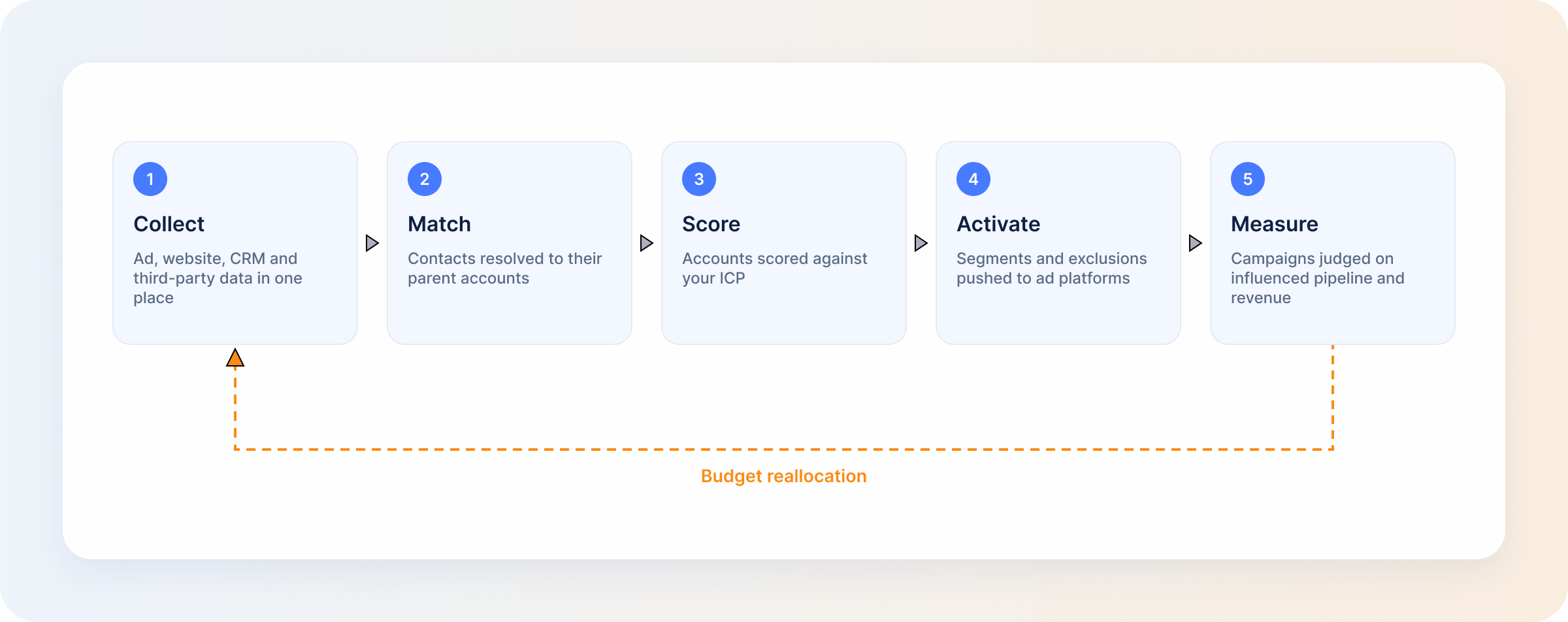
How Marketing Intelligence Platforms Turn B2B Data Into Action
- It collects and connects website, CRM, campaign and third-party data in one place.
- It identifies visitors, including anonymous ones, and matches contacts to parent companies so you get one account-level view instead of scattered records.
- It scores those accounts against your ICP.
- You push segments into your ad platforms, exclude non-ICP accounts, closed deals and competitors, and run tighter campaigns.
- You judge campaigns on influenced pipeline and revenue rather than clicks.
10 Best Marketing Intelligence Platforms for B2B Marketing and Revenue Teams
1. DemandSense: LinkedIn ads joined to pipeline
DemandSense connects LinkedIn ad activity to the accounts in your CRM and identifies the companies and people on your website who never fill in a form. Good fit if LinkedIn is your main paid channel and you can’t currently show what it produced.
Key features: revenue attribution on Awareness, Engagement or Intent presets with a 3, 6 or 12-month lookback; WebID visitor identification scored against your ICP, installed through Google Tag Manager without a developer; the LinkedIn Conversions API, which sends closed-won deals back with their value attached; Audience Tuning, Spend Protection, ad scheduling, and frequency and budget caps.
Pros: attribution and LinkedIn ad controls in one place, so a wasted-spend finding and the fix live on the same screen. Company and contact-level visitor identification, where most LinkedIn attribution tools stop at the company. Native HubSpot, Salesforce and Attio integrations. Won ROAS reported on won deals, not form fills.
Cons: LinkedIn-first, so a team measuring six paid channels equally is better served elsewhere. Most of what is listed above starts on Plus at $149 rather than Basic at $89. Suppression and frequency caps sync weekly.
G2: 5.0 · 14 reviews. Pricing: Basic $89/mo for 200 credits; Plus from $149 on a credit ladder to $999, and the tier where revenue attribution and the ad controls begin; 30-day free trial with all features, no card.
2. HockeyStack: Full-funnel GTM measurement
HockeyStack unifies marketing, sales and product data across the lifecycle and builds account-level journeys from it. Strong if you run a complex multi-channel motion with the data volume to feed it.
Key features: multi-touch attribution across organic, paid and outbound with side-by-side model comparison; Odin, an AI analyst you query in plain language; server-side fingerprinting for cookieless tracking.
Pros: unusually deep cross-channel journey mapping, no-code setup, and model comparison rather than one imposed model.
Cons: built for enterprise data volumes, with a learning curve to match, and no published pricing, so evaluation starts with a sales call.
G2: 4.4 · 82 reviews. Pricing: not published — HockeyStack advertises custom-built plans only.
3. Dreamdata: Attribution on your own warehouse
Dreamdata combines multi-touch attribution, analytics and audience activation, and builds your data models in a warehouse you can query. A fit for teams with analyst resource who want the models, not just a dashboard.
Key features: six attribution models (first-touch, last-touch, linear, U-shaped, W-shaped and data-driven); data cleaning and deduplication across sources; audience activation into LinkedIn, Google, Meta and Microsoft, plus LinkedIn Conversions API.
Pros: a usable free tier, models that live in BigQuery so there is no lock-in on the data, and activation across the major ad platforms.
Cons: the free tier caps at two months of history, five seats, three stage models and one sync. Snowflake is not direct: it routes through cloud storage and needs a paid add-on. Needs volume before the models say much.
G2: 4.7 · 272 reviews. Pricing: free Starter tier; the paid Attribution & Activation tier is custom and unpublished.
4. Factors.ai: ABM and attribution together
Factors.ai pairs multi-touch attribution with account identification and a set of LinkedIn ad controls. Worth a look if you want ABM tooling and attribution from one vendor, and one of the more considered Dreamdata alternatives for teams running several paid channels.
Key features: waterfall visitor identification combining four data sources, which Factors publishes as identifying up to 75% of anonymous traffic at company level and up to 40% of US visitors at person level through an RB2B integration; predictive account scoring; AdPilot, its LinkedIn suite covering frequency capping, impression control, bid scheduling and Conversions API.
Pros: attribution, ABM and LinkedIn ad controls under one subscription, with AdPilot on all tiers including the free one. Cross-channel activation into LinkedIn, Google and Meta.
Cons: person-level identification is a paid add-on and US-only. The pricing page no longer lists prices for the paid tiers, so real cost surfaces only in a sales conversation. The free tier caps at 1,500 companies a month and one month of retention.
G2: 4.5 · 220 reviews. Pricing: free tier (up to 1,500 companies/mo, 3 seats); Basic, Growth and Enterprise are not priced on the pricing page.
5. CaliberMind: Revenue data for RevOps
CaliberMind pulls GTM data across the stack, cleans it and models it so marketing’s contribution to revenue survives scrutiny. Built for larger teams with a warehouse and a RevOps function.
Key features: lead-to-account mapping with fuzzy matching and job-title normalisation; Agent Cal, an AI analyst that returns the SQL and source records behind every answer; first-touch, middle-touch, last-touch, even-weighted and W-shaped models on a lookback you configure.
Pros: the audit trail is the differentiator — you can trace an insight back to the opportunities behind it — and unlimited users on all plans.
Cons: complex setup, a real learning curve, and no published pricing.
G2: 4.5 · 195 reviews. Pricing: not published; volume-based, with unlimited users on every plan.
6. Ruler Analytics: Attribution that includes the phone
Ruler tracks visitors with first-party data and ties form fills, phone calls and live chat back to the campaigns behind them. The pick if a meaningful share of your conversions happen on a call.
Key features: call tracking that links offline phone conversions to the channel, campaign and keyword behind them; marketing mix modelling with diminishing-returns forecasting; attribution at channel, campaign, content and keyword level.
Pros: the strongest offline-to-online join in this list, integration with most CRMs, and published pricing you can budget against.
Cons: tracking is lead-level rather than account-level, which matters for committee-driven deals. Marketing mix modelling is Advanced-tier only. Pricing scales with visit volume, and no free trial is advertised.
G2: 4.6 · 30 reviews. Pricing: Small $400/mo up to 10k monthly visits, rising to Advanced from $2,000/mo above 100k.
7. Fibbler: LinkedIn and Google Ads in one journey
Fibbler connects LinkedIn and Google Ads engagement to CRM deals and builds account-level journeys across both. A good fit if you run those two channels and want one view of them.
Key features: a 12-month lookback before deal creation, with history growing to 24 months the longer you stay; impression caps that push an exclusion into Campaign Manager when a company hits the ceiling; engagement signals routed to Slack, Zapier, Clay or Make by webhook.
Pros: transparent, published pricing, native HubSpot, Attio, Pipedrive and Salesforce support, and Google Ads attribution as an add-on with its own trial.
Cons: company-level identification only, and Fibbler states it does not show individual lead-level data. Salesforce sync starts on the Unlimited tier. Google Ads costs $59 per account per month, and Meta is listed as coming soon. Teams wanting person-level data alongside ad attribution tend to look at Fibbler alternatives.
G2: 4.9 · 32 reviews. Pricing: Growth $89/mo, Unlimited $129, Agency $159; 30-day free trial; Google Ads add-on $59 per account per month.
8. SegmentStream: Incrementality and budget allocation
SegmentStream uses machine learning on first-party data to estimate the incremental value of campaigns, then reallocates budget against it. Suited to teams spending enough across channels that “which of these caused the conversion” is a live question.
Key features: geo holdout experiments using synthetic control modelling to measure incremental lift; marginal analytics showing the return on each additional dollar; synthetic conversions, which model conversions not yet arrived; automated budget allocation across connected ad platforms.
Pros: incrementality testing and attribution in one platform, published pricing with no per-seat charge, and budget changes it executes rather than only recommends.
Cons: expensive next to the LinkedIn-focused tools here, and no free trial. It sells across B2B and ecommerce, so some tooling is aimed at a different buyer.
G2: 4.7 · 26 reviews. Pricing: Online from $800/mo, Full Funnel from $1,200/mo, Enterprise from $5,000/mo.
9. ZenABM: LinkedIn ABM on a small budget
ZenABM is built for LinkedIn ABM campaigns and tracks account engagement across several other channels alongside it. The cheapest serious entry point in this list.
Key features: account engagement tracking across LinkedIn Ads, Google Ads, Reddit Ads and organic traffic; ABM stages written back to the HubSpot company or Salesforce account record daily; Zena, an AI agent you query about campaign performance.
Pros: low entry price and a 37-day trial. HubSpot, Salesforce, Attio, webhooks and API access are on every tier, including Starter.
Cons: CRM stage sync runs once a day, so it won’t drive same-day sales follow-up. LinkedIn-focused, so it won’t replace a broader platform. Its G2 score rests on six reviews.
G2: 5.0 · 6 reviews. Pricing: Starter $59/mo, Growth $159, Pro $399, Agency $479; 37-day free trial.
10. Vector: Contact-level identification and advertising
Vector identifies individual website visitors by name, title and company, then lets you advertise to them directly. The specialist choice when contact-level identification is the point.
Key features: contact-level identification of 15–30% of site traffic alongside account-level identification; off-site research signals from a publisher network Vector puts at 400,000+ sites; ad activation into LinkedIn, Google, Meta, Reddit, TikTok and X.
Pros: fast setup, the clearest published match rates of any vendor here, and cost-per-engaged-contact reporting, which beats CTR as an ad metric.
Cons: no documented revenue or pipeline attribution, so it complements an attribution tool rather than replacing one. Target requires an annual commitment, and match rates vary by traffic source.
G2: 4.9 · 16 reviews. Pricing: Reveal $399/mo for 2,500 identified visitors up to $999 for 10,000, with a 14-day trial; Target $3,000–$4,000/mo on an annual commitment.
How to Choose the Right Marketing Intelligence Platform for Your B2B Stack
- Name the decision you can’t make today. Prioritising accounts for sales and reallocating budget are different problems that point at different tools.
- Map your channels and CRM first. A platform without native support for your CRM costs you an integration project you didn’t budget for.
- Check account-level matching, not just lead-level. Committee-driven deals need contacts rolled up to the company. Ask how the tool identifies anonymous website visitors and how it handles consent.
- Check activation, not only reporting. Ask which ad platforms a tool can push an audience into, and confirm each one works rather than merely appearing in the UI.
- Validate on your own data. Run a trial or paid pilot on your traffic and your CRM. Match rates vary by traffic mix, and no vendor benchmark tells you what yours looks like.
How DemandSense Adds LinkedIn Ads Intelligence to Your B2B Stack
If LinkedIn is your main paid channel, DemandSense is the layer that connects it to accounts, pipeline, and the visitors your forms never catch.
It doesn’t stop at measurement. Ad scheduling, Audience Tuning, frequency caps, and budget caps live alongside the attribution on the same Plus plan rather than behind a separate add-on, which is how Fibbler prices Google Ads attribution and Factors prices person-level identification. When the data shows spend reaching the wrong job titles, you can cut it there and then, and Spend Protection stops spend on accounts that already closed — a leak that hides for months in a Campaign Manager report.
You also set what “influenced” means yourself, with Awareness, Engagement and Intent presets or custom thresholds on a 3-, 6-, or 12-month lookback before deal creation, rather than accepting one fixed model.
There is also a DemandSense MCP server in early access, so you can ask these questions from Claude or ChatGPT rather than reading a dashboard.
Start a 30-day free trial. All features, no card.
FAQ
Do B2B teams need a marketing intelligence platform if they already use a CRM?
A CRM holds the records your sales team enters. It cannot tell you which ads an account saw before it appeared, or who else from that account has been on your site.
Can one marketing intelligence platform replace analytics, attribution, and sales intelligence tools?
Usually not. The categories overlap but don’t merge, and most stacks pair a focused intelligence layer with existing analytics. HockeyStack and CaliberMind cover more ground, at enterprise cost and complexity.
How much do marketing intelligence platforms typically cost?
Published prices in this list run from $59–$89/mo for LinkedIn-focused tools to $5,000/mo for enterprise tiers. Several vendors, including HockeyStack, CaliberMind and Dreamdata’s paid tier, publish nothing at all, so expect a sales conversation before you get a number.
Which integrations matter most for B2B marketing intelligence?
Your CRM first, then your ad platforms, your website and your warehouse if you have one. Ask each vendor to confirm native support rather than a webhook workaround.
Is marketing intelligence software useful for small B2B teams?
Yes, provided you buy for the channel you actually run. A small team doesn’t need an enterprise data platform. If LinkedIn ads and account-level engagement are the question, focused tools like DemandSense, Fibbler and ZenABM cover it far more cheaply.
What’s the difference between marketing intelligence and market intelligence?
Marketing intelligence analyses your own marketing data, engagement and revenue to explain campaign performance. Market intelligence looks outside the company at competitors, demand and market conditions. One improves what you run; the other tells you where the market is going.