
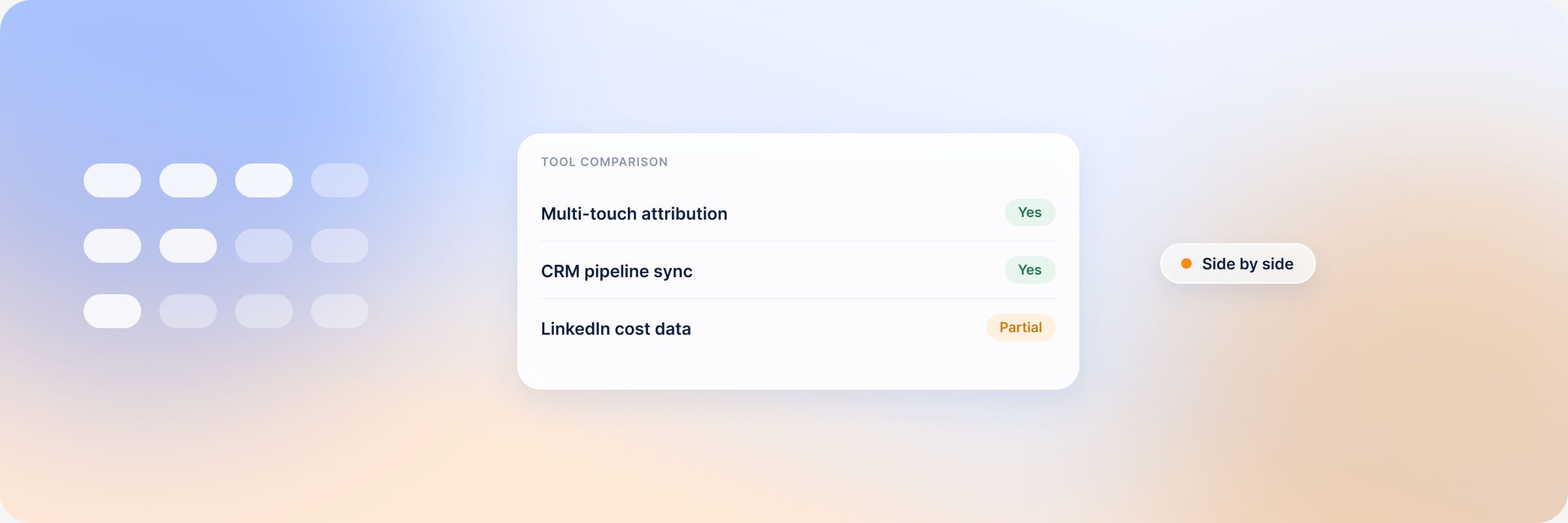
Factors.ai’s account intelligence is genuinely strong. The company claims it identifies more than 75% of companies visiting a website — among the highest match rates in the category — and pairs that with six built-in multi-touch attribution models. The catch is what happens after identification: on Factors.ai’s own plans, identification is company-level, and resolving the individual behind the visit is a separate paid add-on. Buyers on G2 also wish it had more reporting and customization options.
Our top three picks:
| Tool | Best for |
|---|---|
| DemandSense | Teams that want to identify visitors and trace LinkedIn ad spend to closed revenue |
| RB2B | Teams that want person-level identification as the product, not a paid add-on |
| Warmly | Teams that want identified accounts to trigger automated outreach, not just a dashboard alert |
What Is Factors.ai?
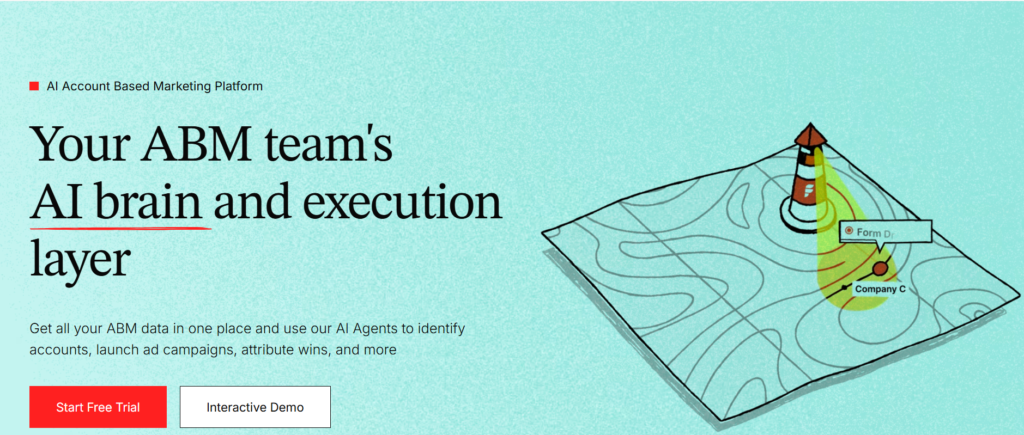
Factors.ai is an AI-driven account intelligence and multi-touch attribution platform that identifies companies visiting a website, scores them based on engagement, and maps buyer journeys across channels including website, CRM, LinkedIn, and G2.
Core strengths:
- Claims identification of more than 75% of companies visiting a website, among the highest match rates in the category — though that figure applies from the Basic plan up, not the entry-level Lite tier, and the coverage is company-level. Person-level identification is a separate paid add-on.
- Six built-in multi-touch attribution models covering website, CRM, LinkedIn, and Google Ads engagement. The LinkedIn integration is one of the platform’s most-praised features on G2, though a few reviewers say the reporting could be clearer.
- Broad multi-channel intent tracking that merges website, CRM, LinkedIn, and G2 engagement into one view — though a number of users describe the sheer breadth of options as overwhelming for routine tasks, with several calling the learning curve steep.
- Native integrations with Slack, HubSpot, and major ad platforms for a unified lead view.
Why Consider Factors.ai Alternatives?
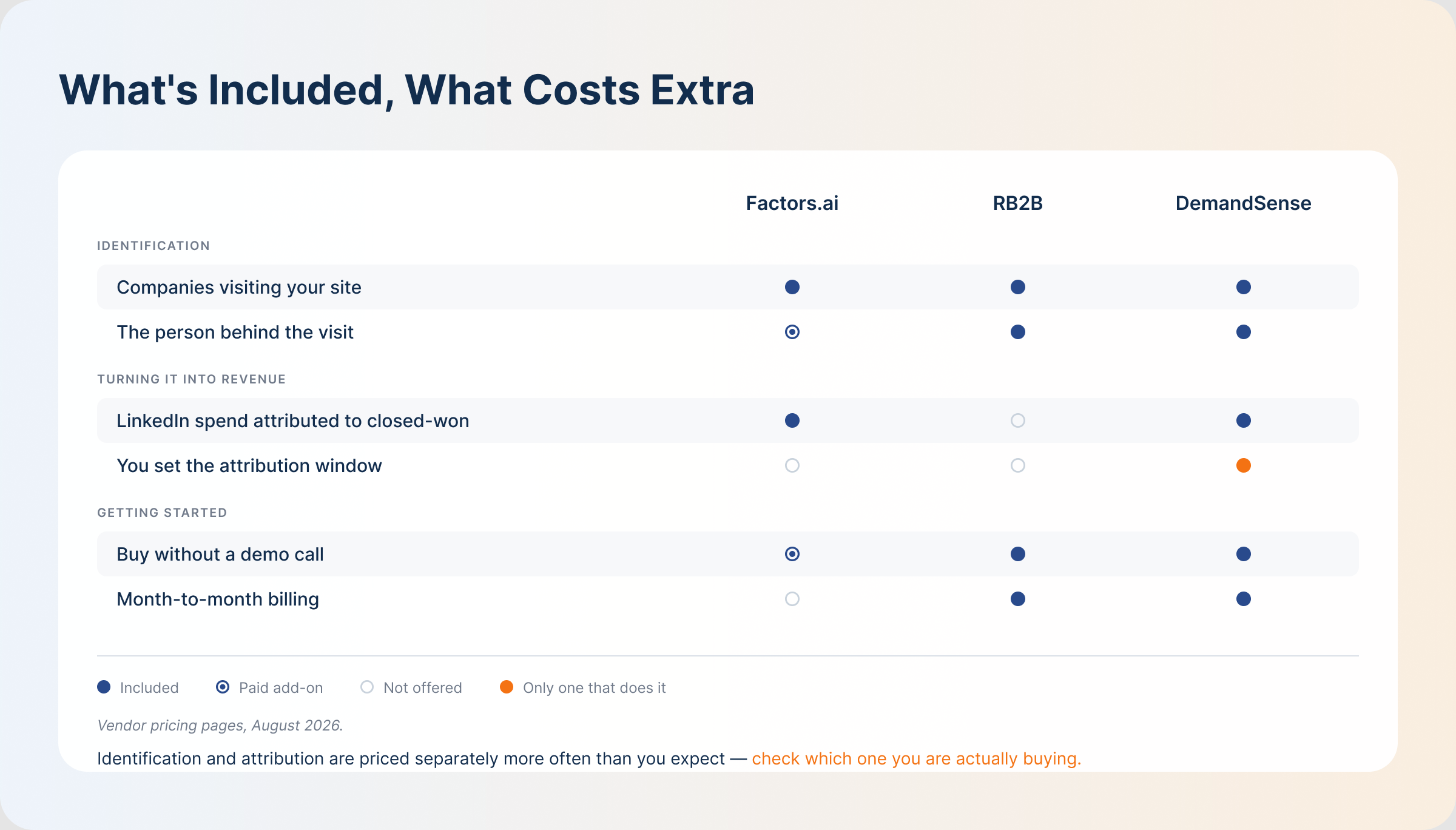
Person-level identification isn’t included. On Factors.ai’s own plans, identification is company-level: when a visitor’s personal data isn’t available, you get the organization, not the individual. Person-level identification is available, but only as a paid add-on layered on top of Basic or above. For teams whose follow-up depends on knowing who to contact rather than just which company to target, that’s another line item on a contract that already starts at $6,000 a year.
The learning curve is a recurring, specific complaint, not a one-off. A number of users on G2 mention a steep learning curve as a con. A tool that takes longer to operationalize delays time to first value, which matters for teams that need to show ROI quickly.
LinkedIn reporting can be hard to read. Most reviewers rate the LinkedIn integration positively, but a handful say it needs work — including one who found the ad impression timing report difficult to interpret, unable to tell whether a visitor saw the LinkedIn ad first or arrived from a Google search. For teams whose core question is “did our LinkedIn spend work,” that ambiguity is worth testing during a trial. It’s the same gap that makes a clear LinkedIn attribution model worth setting up deliberately rather than inheriting from a platform default.
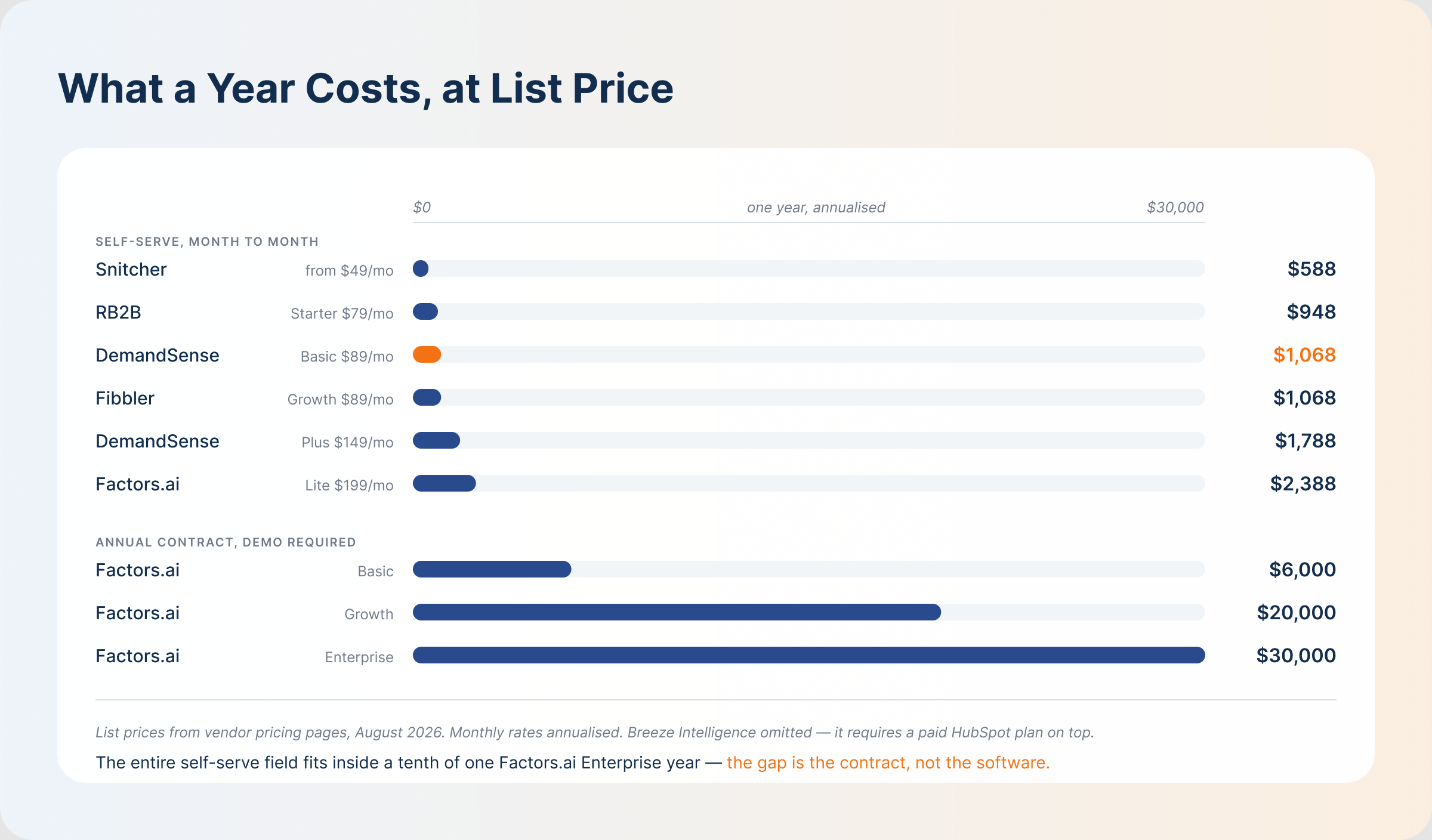
The price can be high for small businesses and startups. Factors.ai’s Lite plan is free for one month, after which it moves to $199 per month. Basic is $6,000 per year, Growth is $20,000 per year, and Enterprise starts at $30,000 per year, typically on an annual contract.
Here is a quick overview of the top 7 Factors.ai alternatives:
| Tool | Best for | Core strength | Why choose it over Factors.ai | G2 rating | Pricing |
|---|---|---|---|---|---|
| DemandSense | Revenue teams that want to identify visitors and tie LinkedIn spend to pipeline, fast, without an enterprise sales process | Attribution presets you control, connecting LinkedIn touchpoints to closed-won deals, plus WebID company and person identification | Factors.ai locks pricing behind a demo call. DemandSense publishes its price and gives you 30 days to test every feature | 5/5 | Base $89/mo, Plus $149/mo, 30-day free trial |
| RB2B | Teams that need a name, not just a company, on every visit | Person-level matching as the core product, not a paid add-on | Factors.ai identifies at company level and charges extra for person-level. With RB2B the individual is the product | 4.5/5 | Free tier (company-level); Starter $79/mo, Pro from $149/mo |
| Warmly | Teams that want the identified account worked, not just flagged | AI agents running outbound and inbound plays automatically | Turns identification into action, cutting past the setup Factors.ai reviewers call a steep learning curve | 4.5/5 | Custom, contact sales |
| Clearbit (Breeze Intelligence) | Teams that want enrichment inside a CRM they already run | Deep firmographic and technographic data layered on identification | One less platform to learn, versus Factors.ai’s steep learning curve | 4.4/5 | From $45/mo in credits on top of a paid HubSpot plan |
| Fibbler | Teams whose attribution question begins and ends with LinkedIn and Google Ads | Flat, published pricing tied to ad-to-pipeline attribution | A focused tool at a fraction of the cost and setup time of Factors.ai’s full platform | 4.9/5 | Growth $89/mo to Agency $159/mo, 30-day trial |
| Snitcher | Teams that balked at Factors.ai’s price floor | Flat, scalable company-level pricing with a genuine free trial | Starts under $50/mo against Factors.ai’s $199/mo entry price | 4.8/5 | From $49/mo |
| Lead Forensics | Enterprise teams that need proven scale without platform complexity | Long-standing vendor, unlimited seats, enterprise CRM depth | Roughly five times Factors.ai’s G2 review base, with a longer track record at volume | 4.4/5 | Custom, typically $6,000 to $35,000/year |
DemandSense
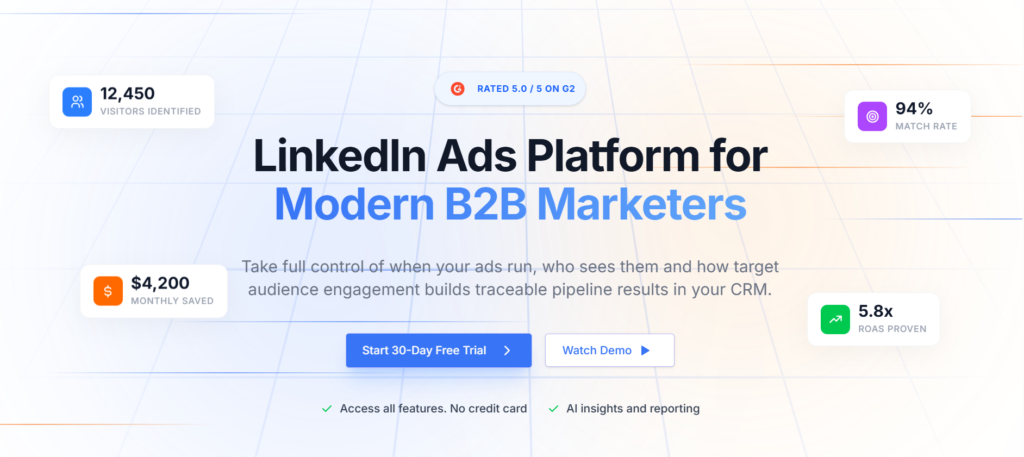
Factors.ai builds a case for breadth: six attribution models, multi-channel intent tracking, a claimed 75%+ company match rate. DemandSense builds a case for a specific answer — what did your LinkedIn spend actually turn into. You define what “influenced” means, using three presets or your own thresholds, and follow LinkedIn touchpoints through to closed revenue without the steep setup curve or gated pricing that comes with Factors.ai’s fuller platform.
Where DemandSense beats Factors.ai
- Publishes pricing at $89/mo on Base and $149/mo on Plus, with a 30-day free trial and no credit card required. Factors.ai’s Lite plan is free for one month, then $199 per month, with Basic at $6,000 per year, Growth at $20,000 and Enterprise from $30,000.
- You decide what counts as influence. Three attribution presets — Awareness, Engagement and Intent — or your own thresholds, with a lookback window up to 12 months to match a real B2B buying cycle.
- Ties LinkedIn touchpoints to closed-won revenue, not just an engagement score, which is the part most teams struggle to connect LinkedIn impressions to pipeline on their own.
- WebID identifies both the companies and the individual people on your site, without Factors.ai’s company-level default and paid person-level add-on.
- You install it yourself through Google Tag Manager — no developer ticket, no implementation project.
G2 Rating: 5/5
Pricing: Base $89/mo, Plus $149/mo, 30-day free trial
RB2B
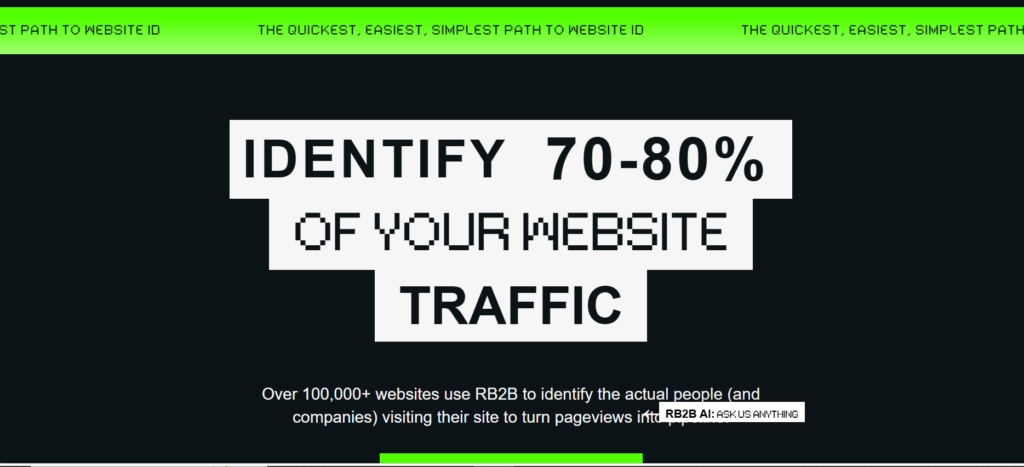
Factors.ai’s identification is company-level by default, with person-level resolution sold as an add-on. RB2B was built around the opposite priority: resolving the individual, not the account, with real-time alerts the moment a known person lands on the site.
Worth knowing before you compare the two: RB2B publishes its own coverage numbers, and they’re specific. Contact-level identification is US-only and covers 15–20% of visitors on the Starter and Pro plans, rising to 35–45% on Pro+. The free plan is company-level only — no person-level ID and no email addresses. That’s a smaller share of traffic than Factors.ai’s 75% company-level claim, because it’s measuring something harder.
Where RB2B beats Factors.ai
- Person-level matching is the core product rather than a paid add-on, so the individual is what you’re buying, not an upsell.
- Simpler setup and real-time Slack alerts, without a steep learning curve.
- Starts lower than Factors.ai, with a genuinely free company-level tier for teams that just want to identify companies visiting your website before paying for anything.
G2 Rating: 4.5/5
Pricing: Free tier (company-level only); Starter $79/mo, Pro from $149/mo, Pro+ from $199/mo
Warmly
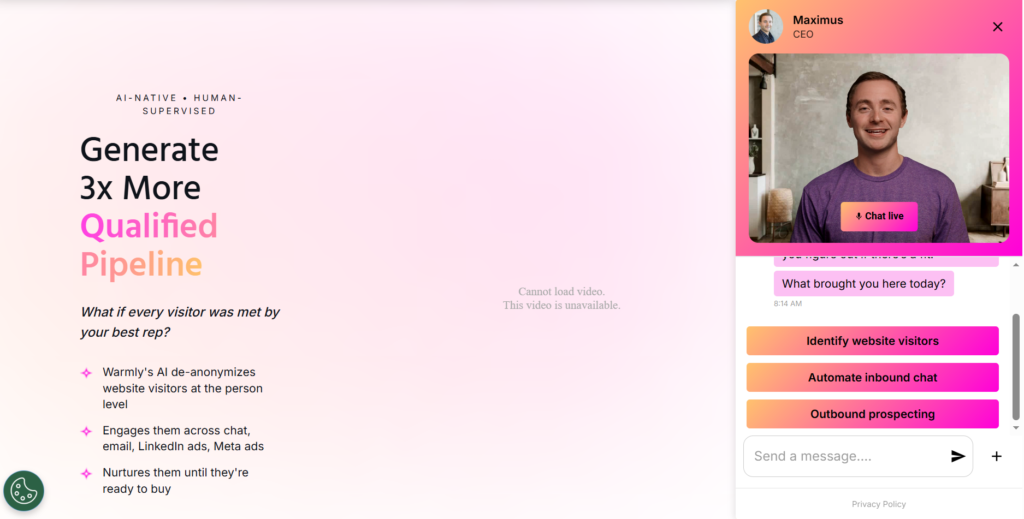
Factors.ai scores accounts and surfaces them across a multi-channel dashboard, but acting on that data still falls to a rep. Warmly closes that gap with two AI agents — one working outbound prospecting, one engaging inbound traffic — so identification turns into outreach automatically.
Where Warmly beats Factors.ai
- AI agents act on identified accounts automatically, rather than leaving a rep to interpret a scoring dashboard.
- Combines outbound and inbound motion in one platform instead of Factors.ai’s attribution-only focus.
- Turns buyer intent tracking into a queue of conversations rather than a report someone has to read first.
G2 Rating: 4.5/5
Pricing: Custom, contact sales
Clearbit (HubSpot Breeze Intelligence)
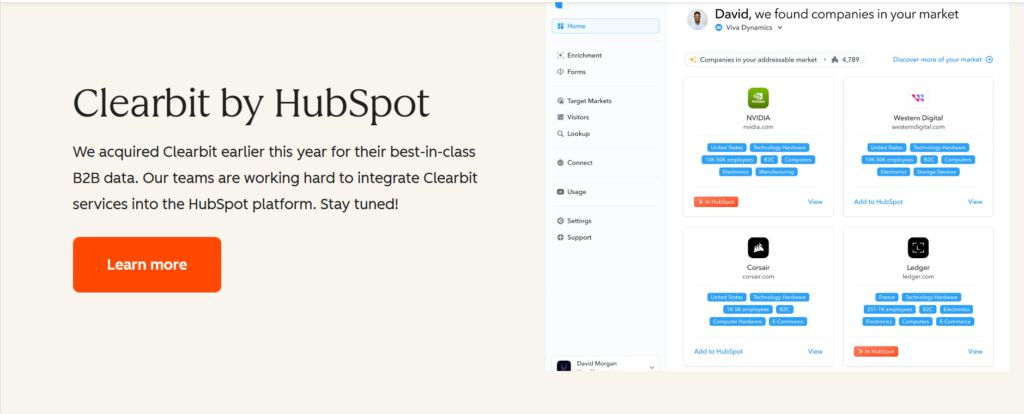
Where Factors.ai asks teams to adopt a new, fairly complex standalone platform, Clearbit’s enrichment runs natively inside HubSpot as Breeze Intelligence. For teams already committed to that ecosystem, it’s one less interface to learn and one less login to manage.
Where Clearbit beats Factors.ai
- Runs natively inside HubSpot workflows, avoiding a separate platform with its own learning curve.
- Firmographic and technographic enrichment layered directly onto identification.
- Lower, more predictable entry cost for teams already paying for HubSpot.
G2 Rating: 4.4/5
Pricing: Requires an active paid HubSpot subscription; Breeze Intelligence credits from $45/mo on annual billing ($50 monthly) for 100 credits
Fibbler
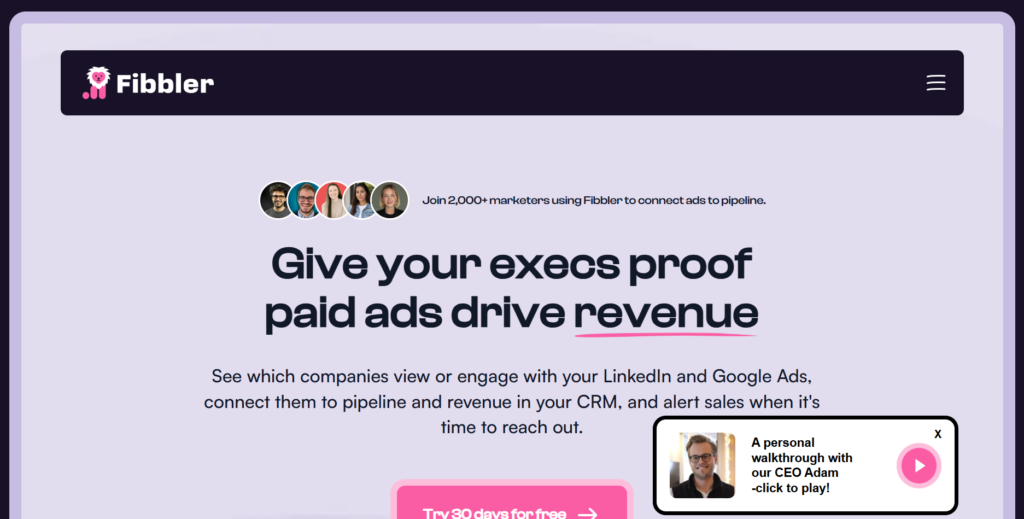
Fibbler does one thing — tying LinkedIn and Google Ads engagement to the CRM pipeline — and charges a flat rate for it. For teams that only need that specific slice of what Factors.ai offers, Fibbler skips the broader multi-channel complexity, and the setup time, that comes with Factors.ai’s fuller platform.
Where Fibbler beats Factors.ai
- Flat, published pricing starting at $89/mo with a 30-day free trial, versus Factors.ai’s demo-gated annual plans.
- Focused specifically on LinkedIn and Google Ads attribution, without the steep learning curve of a broader multi-channel platform.
Its most common limitation in reviews is the lookback window: date filtering caps out around 90 days, and several reviewers ask for up to 12 months — worth checking against your own sales cycle length. If that ceiling is the dealbreaker, the Fibbler alternatives comparison goes deeper on where it runs out.
G2 Rating: 4.9/5
Pricing: Growth $89/mo, Unlimited $129/mo, Agency $159/mo, 30-day free trial. Google Ads add-on $59/mo
Snitcher
Snitcher and Factors.ai both identify who’s on your site, but at different depths. Snitcher is a lean, company-level tool from $49/month with a real free trial. Factors.ai adds multi-touch attribution and account scoring, starting at $199/month self-serve but jumping to $6,000/year once you need LinkedIn Ads tracking or CRM sync. Snitcher fits teams that just need to know who’s visiting; Factors.ai fits teams that also need to know which channels are driving them.
Where Snitcher beats Factors.ai
- Transparent pricing from $49/mo, a quarter of Factors.ai’s $199/month entry price.
- A 14-day free trial with no credit card and no sales call.
- Simpler, company-level focus without the steep learning curve Factors.ai reviewers describe.
G2 Rating: 4.8/5
Pricing: From $49/mo, scaling with identified companies; 14-day free trial
Lead Forensics
Factors.ai’s multi-channel breadth can come with a cost at scale: one G2 reviewer describes the platform prompting them to come back in roughly sixty minutes for filter results on a large dataset. Lead Forensics, with a longer G2 track record, offers a more established, simpler alternative built for enterprise scale.
Where Lead Forensics beats Factors.ai
- A far longer track record at volume, with roughly five times the review base of Factors.ai.
- Unlimited seats on every plan, with deep native CRM integrations across Salesforce, HubSpot, Pipedrive, Zoho, and Microsoft Dynamics.
G2 Rating: 4.4/5
Pricing: Not published; custom quotes; contact sales
When Teams Should Choose DemandSense Over Factors.ai
Choose DemandSense to:
- Trace LinkedIn spend all the way to closed-won revenue, not just an engagement score.
- Decide for yourself what “influenced” means, with three attribution presets or your own thresholds and a lookback window up to 12 months that follows a real B2B buying cycle.
- Keep setup simple — install through Google Tag Manager yourself, without the learning curve Factors.ai’s own reviewers flag repeatedly.
- Give marketing and sales the same source of truth on what’s actually driving pipeline, the way a working account-based marketing attribution model should.
You might need to explore Factors.ai alternatives if you:
- Need more than basic company identification without booking a demo, since Lite caps at 1,500 companies per month and everything past it requires a sales call.
- Aren’t ready for an annual contract, since Basic and above are billed yearly starting at $6,000 per year, not month-to-month.
- Have hit the steep learning curve reviewers describe and don’t have weeks to spare getting the team fully onboarded.
- Need person-level identification specifically, since Factors.ai resolves at company level and charges for the individual as an add-on.
FAQs
But doesn’t Factors.ai identify way more visitors, with a 75%+ match rate?
That figure is Factors.ai’s own claim, and it’s worth acknowledging — identifying more than 75% of companies visiting a website would be among the highest in the category. Two things to hold alongside it. First, the number applies from the Basic plan up, not the entry-level Lite tier. Second, it’s a company figure: person-level identification is sold separately as an add-on, so the headline percentage and the individual prospect aren’t the same purchase.
DemandSense’s WebID identifies the people on your site as well as the companies, and follows every LinkedIn touchpoint through to closed revenue — which is the number a company match rate doesn’t give you on its own. Identification rates depend heavily on your traffic mix, and person-level coverage runs materially lower than company-level coverage across every tool in this category. The useful comparison is what each tool resolves on your own site, not a headline percentage.
Factors.ai covers six attribution models across every channel. Isn’t that more complete than DemandSense’s LinkedIn-only focus?
Breadth is genuinely Factors.ai’s strength, and it’s fair to say so. But that same breadth is why G2 reviewers list a steep learning curve among the platform’s most frequent complaints. DemandSense trades breadth for depth on the channel most B2B teams need answered — LinkedIn — and lets you set the attribution rule yourself rather than configuring six models first. Pick a preset, or set your own thresholds and lookback window, and you get straight to whether the spend closed revenue. If you’re weighing the wider field, our roundup of the best attribution software for B2B LinkedIn advertisers covers the trade-off in more detail.
Isn’t Factors.ai’s free tier a better deal than DemandSense’s paid plans?
Factors.ai’s “free” tier is really Lite at $199/month after the first month, capped at 1,500 companies and missing the attribution and CRM features Factors.ai is known for. Those live in Basic, which starts at $6,000/year, billed annually, demo required. So it’s not really “free vs. paid” — it’s “$6,000 upfront for a year vs. DemandSense at $89/month with a 30-day free trial, no credit card, and no lock-in.”