
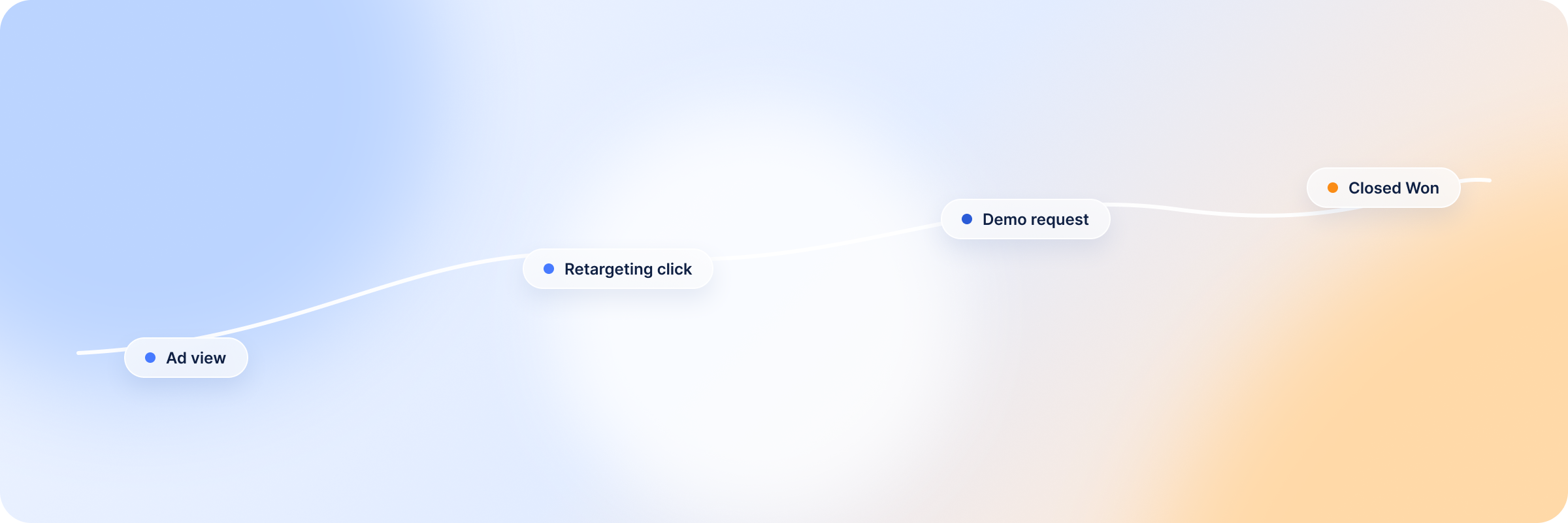
Summary: Why Impression Attribution Matters for LinkedIn Ads Measurement
Impression attribution measures how ad impressions, as well as clicks, influence a buyer’s path to conversion. On LinkedIn that difference is large. At a benchmark CTR of 0.52%, click-only measurement judges a campaign on about half a percent of the impressions it served. The other 99.5% still shape brand awareness and the customer journey, but click-based attribution leaves them out of the report. This article covers how impression attribution works, how it compares with click-through measurement, what attribution windows and frequency do to the numbers, where it breaks down, and how DemandSense approaches it.
What Is LinkedIn Impression Attribution?
LinkedIn impression attribution gives ad views, clicked or not, credit for influencing what an account does later: a site visit, a demo request, a new opportunity. It’s easy to mix up with an impression count, but the two measure different things. An impression count is the raw number of ad views. It’s useful for reach and says nothing about what those views did. Impression attribution goes a step further and connects the fact that an account saw an ad to what that account did afterward.
In B2B specifically, this distinction matters because most of what an ad accomplishes never shows up as a click. A prospect scrolling past a LinkedIn ad, registering the brand, and moving on is still exposure. Impression attribution treats that exposure as a data point in the buyer’s journey, alongside clicks, site visits and CRM activity, instead of discarding it because no click occurred.
Not every ad view counts as an impression, either. Under LinkedIn’s viewability rules for Sponsored Content, a desktop impression is counted once at least 50% of the ad has been in view for one second. LinkedIn updated the mobile rule in August 2026: an impression now counts when at least 50% of the ad, or at least 300dp of it (density-independent pixels), is in view for 300 milliseconds. The change mostly affects tall ads that don’t fit on a phone screen. That threshold is what separates a served ad from a counted one, and the counted impression is the exposure event impression attribution builds on.
How Does LinkedIn Impression Attribution Work?
Impression-based attribution runs in four steps:
- An ad is served to a LinkedIn member, and once it passes the viewability threshold, LinkedIn records an impression.
- That impression is recorded against the individual member, then rolled up to the company they work for.
- Weeks or months later, the account converts: someone fills out a form or starts a trial, or the account opens as a sales opportunity.
- The attribution model looks back over a defined attribution window and credits some portion of that outcome to the earlier exposure.
The account-level rollup in step two is the part that matters most. In consumer advertising, attribution usually stays at the individual level, because one person makes one purchase decision. B2B doesn’t work that way. A buying committee spreads across procurement, finance and the team that will use the product, and there’s no guarantee that the person who saw the ad is the one who clicks or converts.
By rolling impressions up to the company rather than the member, impression attribution can connect an ad shown to a director in finance with a deal closed three months later by someone in operations, as long as both sit inside the same account.
None of this proves the impression caused the conversion. The model sees exposure and an outcome inside the same account and the same window, and estimates credit from that correlation. It’s worth remembering when you decide how much weight to put on the numbers.
Why Impression Attribution Matters for Modern B2B Measurement
Four things make impression data hard to ignore in B2B:
- Buying committees research quietly. In B2B, much of a deal happens before anyone fills out a form. A director in finance and a manager in operations might both see a campaign, read around it, and never click, yet both shape the outcome. Click-based measurement never registers that research, which means it misses most of the committee.
- Long sales cycles separate cause from effect. A LinkedIn ad seen in March might influence a deal that closes in September. By then the click, if there was one, has dropped out of any short attribution window. Measurement that only looks back a few days misses the exposure that mattered.
- Last-click hands the credit to the wrong channel. A prospect who saw a LinkedIn ad weeks earlier often converts by typing the company’s name into Google or going to the site directly. Last-click attribution rewards that final touchpoint, branded search or direct traffic, and erases the ad campaign that built the intent in the first place.
- Click chains keep getting less reliable. Safari and Firefox restrict third-party cookies by default, consent banners and ad blockers drop more of the trail, and buyers switch between phone and laptop mid-research. Each of those breaks the path from click to conversion. Account-level impression measurement doesn’t depend on that path surviving intact, so it holds up better as tracking gets harder.
Impression Attribution vs. Click-Through Attribution: What’s the Difference?
Here’s how the two compare:
| What It Credits | What It Needs | What It’s Good For | Where It Misleads | |
|---|---|---|---|---|
| Impression attribution | Ad views, whether or not the viewer clicks | A counted impression, rolled up to the account | Capturing brand awareness and quiet research across a buying committee | Can over-credit LinkedIn by giving weight to exposure that did little on its own |
| Click attribution | A direct interaction with the ad | A recorded click tied to a conversion event | Measuring immediate, intent-driven response | Under-credits LinkedIn by ignoring every touchpoint that didn’t end in a click |
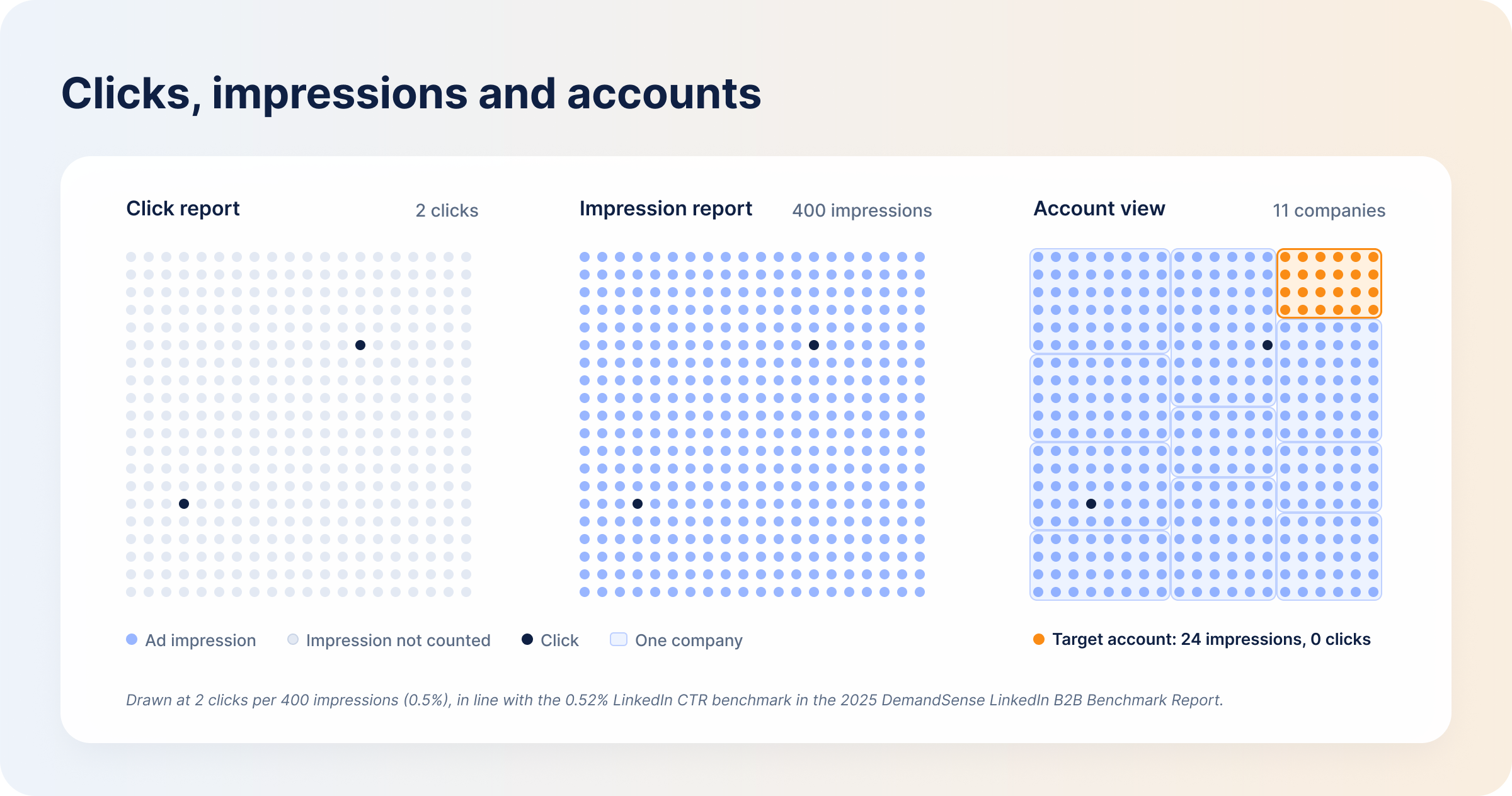
Click attribution is the right lens for short, direct-response campaigns, where the goal is an immediate action, and the buying decision doesn’t need several stakeholders to weigh in first. Impression attribution fits longer B2B cycles, where a campaign’s job is to build awareness across a committee long before anyone clicks anything.
Neither model is complete on its own. Click attribution under-credits LinkedIn, because it ignores every exposure that didn’t end in a click. Impression attribution can over-credit it, because exposure alone doesn’t guarantee influence. A serious measurement setup runs both and treats the gap between them as the thing worth investigating.
How Attribution Windows and Impression Frequency Affect LinkedIn Measurement
Attribution windows. A longer attribution window catches more of a B2B sales cycle, which matters when a deal takes months to close and the exposure that mattered happened early. But a longer window also sweeps in coincidence, crediting an impression for a conversion it may have had nothing to do with. A shorter window is more conservative and less prone to false credit, but it can miss the early research that started the buying process. In DemandSense, for example, the lookback can be set to 3, 6 or 12 months. The number matters less than the discipline: pick a window and keep it fixed. Change it mid-quarter and your quarter-over-quarter comparison stops meaning anything, because the shift in the number could be the window rather than the campaign.
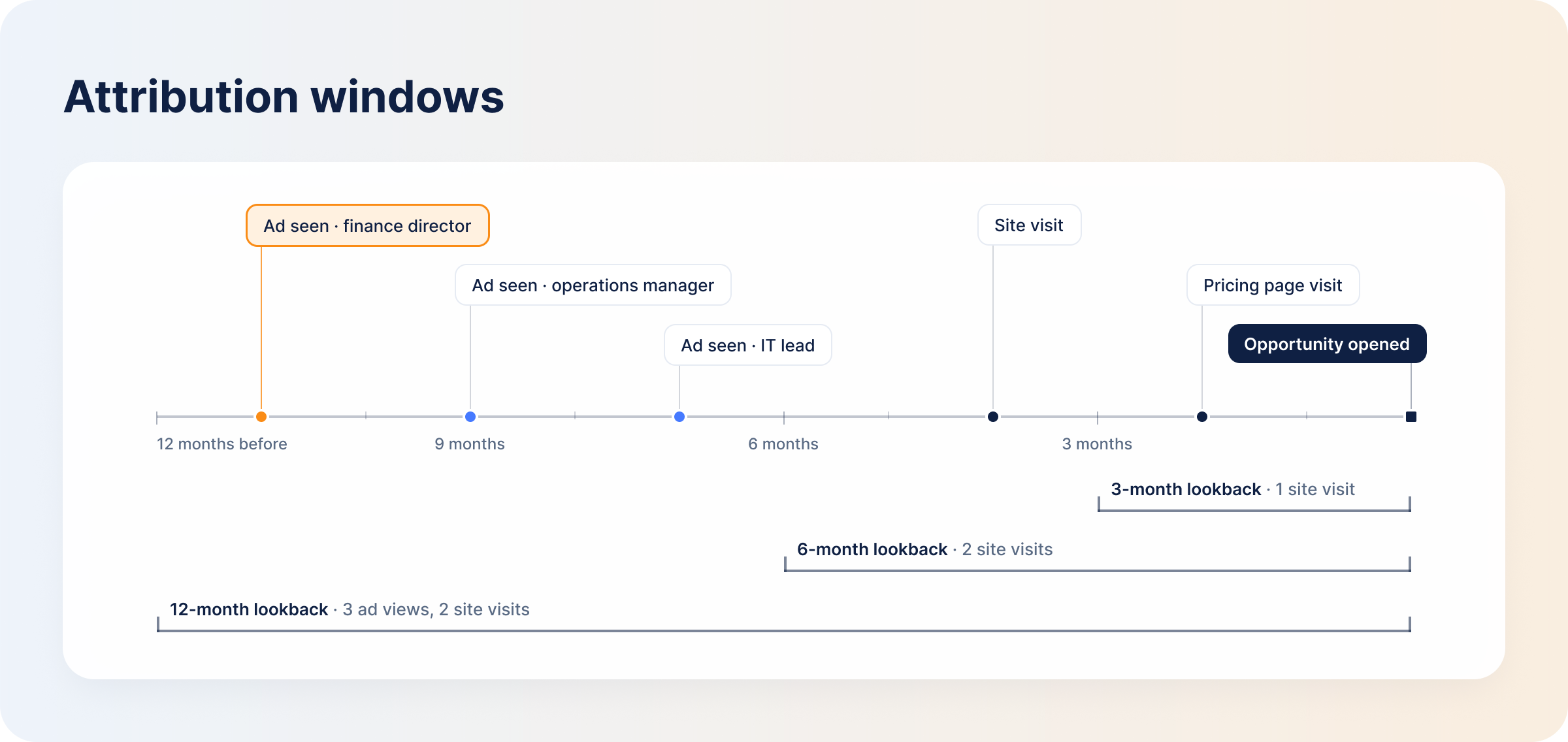
Frequency. Exposure spread across several people at one account, say someone in finance, someone in operations and the person who’ll own the rollout, is the pattern impression attribution is built to catch. That’s a committee forming an opinion. One person seeing the same ad twelve times is a different story. It looks more like fatigue, and it should count as one signal rather than twelve votes of interest. The control for over-exposure sits on the delivery side: DemandSense’s Frequency Cap limits how often any one company sees your ads, enforced in a weekly batch, so budget moves off accounts that have already seen enough.
What Can Impression Attribution Reveal About B2B Campaign Performance?
Once exposure is tracked at account level, a few findings show up that a click report can’t give you:
- Which campaigns reach target accounts, even with zero clicks. A campaign with a flat CTR can still be landing consistently on the accounts that matter, which a click-only report would call a failure.
- Which accounts are quietly researching. Rising impressions across several people at one company, without a single click, can be an early sign that a deal is forming, before it shows up in any other system.
- Whether upper-funnel spend is doing anything at all. Awareness and consideration campaigns rarely produce clicks by design. Impression data tells you whether that spend reaches the right accounts or goes to the wrong audience.
- Which segments are over-exposed. A segment with high frequency and no movement toward conversion is a signal to pull back, reallocate budget or rework the creative before fatigue sets in.
For account-based programs, this is the evidence you’d use to move accounts between tiers, and the first input to account-based marketing attribution.
Challenges and Limitations of Impression Attribution
Impression attribution has real limits, and they’re worth stating plainly:
- It cannot prove incrementality. An attribution window shows correlation between exposure and conversion over time. It can’t show that the impression caused the outcome. Timing, a competitor’s move or an unrelated event could explain the same pattern.
- A recorded impression isn’t a guaranteed human view. A viewability threshold only says the ad was on screen. Whether anyone looked at it or registered it is another question. On the LinkedIn Audience Network the bar is lower still: an impression counts when the ad renders on the partner’s page.
- Over-crediting is the default failure mode. Give impressions credit for everything downstream and every campaign starts to look successful, because almost every account was exposed to something at some point. This is the usual way the model goes wrong.
- Cross-device and privacy constraints break the identity chain. A member seen on mobile who converts later on desktop, or who has opted out of tracking, leaves a gap the model can’t close. Some real exposure goes unrecorded or unmatched.
- Platform-reported data is the platform grading its own work. LinkedIn counts its own impressions, and in its Revenue Attribution Report it also decides how much credit they earn. The numbers can still be right. Read them next to data LinkedIn doesn’t control, like your CRM and your own site traffic.
Impression attribution is still worth running. Treat it as a lens that shows a pattern, and check it now and then with a holdout test or an incrementality study that measures what happens when the exposure is withheld.
How DemandSense Measures LinkedIn Impression Influence Across Pipeline and Revenue
LinkedIn’s own reports can show which companies saw your ads and, with a CRM connected, which of them became revenue. They stop at the edge of LinkedIn, and revenue only shows up once the budget that earned it has been spent. DemandSense reads the pattern earlier and wider.
It starts with the companies behind your campaign engagement, and it surfaces more of them than Campaign Manager’s own reports show. You then decide what “influenced” means in your LinkedIn attribution model. The Awareness preset is the one built for impressions: it counts exposure as influence when it falls inside a lookback window you set and keep fixed. Journeys lay out each account’s touchpoints as a timeline, so an impression sits in sequence with the ad clicks, site visits and other engagement around it instead of standing alone as a headline number.
Sensor Pixel is how DemandSense identifies website visitors. It names the companies and people who come to your site without filling anything in, scores them against your ICP, and shows which of the accounts your ads reached later came to look. Google Ads, Facebook Ads and StackAdapt connect too, so LinkedIn exposure is read next to your other paid channels. HubSpot, Salesforce and Attio connect natively (webhooks cover other systems), and influenced pipeline and Won ROAS, revenue on won deals against spend, sit next to the exposure data.
Because the read comes while campaigns are still running, you can act on it. Frequency Cap limits how often any one company sees your ads, and Spend Protection stops spend on accounts that have already closed.
None of this proves an impression caused a deal. It shows where exposure sits in each account’s path to pipeline, which is what the data can support.
Try it on your own campaigns, free for 30 days, no card.
FAQ
Is Impression Attribution the Same as View-Through Attribution?
Closely related, but not identical. LinkedIn view-through attribution credits a specific person who saw an ad and converted later without clicking it. Impression attribution is the broader practice of crediting exposure with influence, and in B2B it usually works at account level rather than person level.
When Is Impression Attribution Useful for B2B Campaign Measurement?
It’s most useful for upper-funnel and ABM campaigns run against a defined target account list, for long sales cycles where the converting click is far removed from the ad, and for any program judged on reach into target accounts rather than form fills alone.
Does LinkedIn Impression Attribution Over-Credit Conversions?
It can. A wide attribution window over a large audience means some credited accounts would have converted anyway, ad or no ad. The control is a comparison: hold out a segment from the campaign, or compare exposed and unexposed accounts of similar fit, and credit only the difference.
What Attribution Window Should B2B Teams Use for LinkedIn Impressions?
There’s no universal answer. Match the window to your actual sales cycle, then keep it fixed so comparisons over time stay meaningful. DemandSense, for example, offers lookbacks of 3, 6 or 12 months.
Can a LinkedIn Ad Influence Pipeline If Nobody Clicks It?
Yes. As the benchmark CTR in the summary shows, almost everyone who sees a LinkedIn ad scrolls past without clicking, and that exposure still shapes awareness and consideration well before any conversion.
Is Account-Level Impression Attribution Better for B2B Than Contact-Level Attribution?
Account-level impression attribution is better suited to B2B, though contact-level attribution still has its place. B2B purchases are made by groups of people, so the account is the unit that matches how deals get decided. Contact-level detail still matters for sales follow-up and outreach.
Where Does LinkedIn Report Impression-Based Attribution?
Campaign Manager reports impressions, reach, frequency and view-through conversions inside its own conversion windows. Companies Hub breaks paid impressions and engagement down by company, above LinkedIn’s reporting thresholds. The Revenue Attribution Report in Business Manager goes furthest: with Salesforce, Dynamics 365 or HubSpot connected, it credits revenue to impressions at member or company level, with lookbacks of up to 365 days. All three only see LinkedIn touchpoints, which is why teams also work on connecting LinkedIn impressions to pipeline with their own site and CRM data.